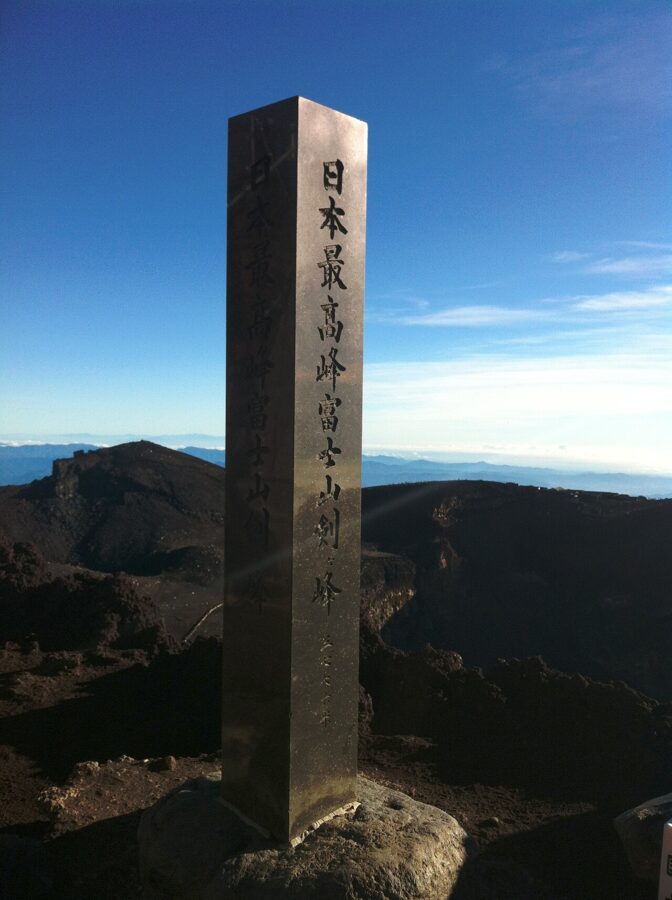
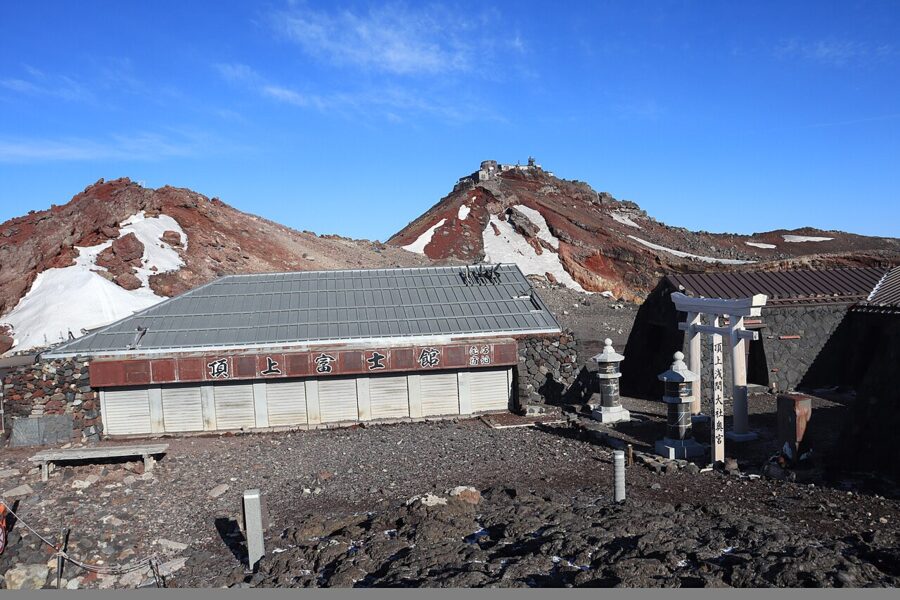
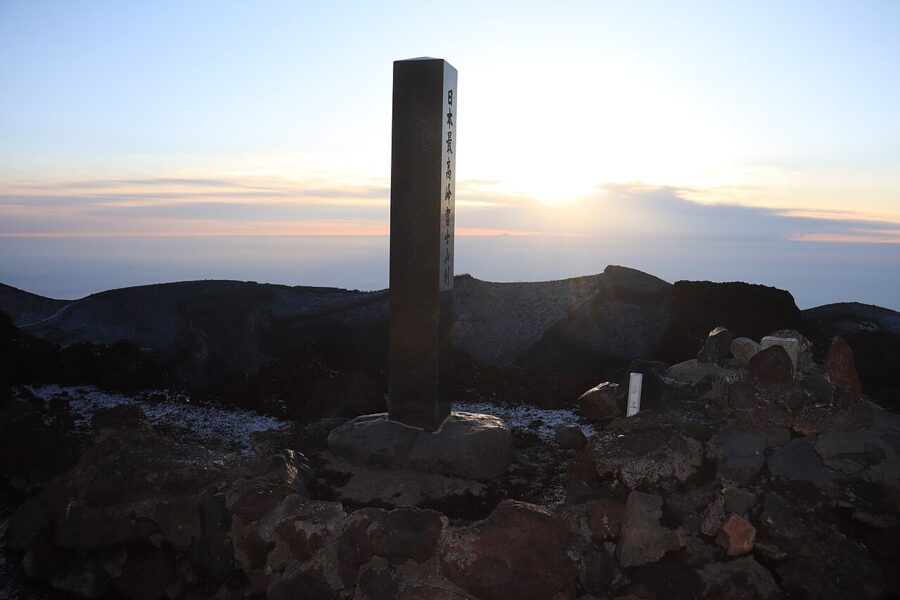
The last thing you read before the top of Japan is a stone post on the crater rim. It says 日本最高峰 富士山 剣ヶ峰: highest peak in Japan, Mount Fuji, Kengamine. Of the three characters in the mountain’s name, only the last one is sure of itself.
That last one is 山, mountain, and it is why Japanese people say Fujisan (富士山). The first two, 富士, mean something like “wealth” and “warrior”, and nobody believes that is what the name meant. They are a spelling, chosen for sound, sitting on a word whose origin has been argued over for more than a thousand years.
The mountain under the name is easier to pin down. Fuji is a volcano of 3,776 m (12,388 ft) on the border of Yamanashi and Shizuoka, about 100 km south-west of Tokyo on Honshu. It last erupted in 1707, it is still classed as active, and in 2013 it was listed by UNESCO as a cultural site, not a natural one. That last fact is the clue to everything else: Fuji matters in Japan for what people have written, painted, prayed and climbed on it.
In this article
The name: 富士, 不二, 不尽 and the stories behind them
Read 富士 character by character and you get フ (fu) from 富 and シ (shi) from 士, voiced to ji. The characters were picked for sound and for flattering meaning, as with many Japanese place names. The oldest texts did not agree on the spelling at all.
The dictionaries collected on Kotobank list 不尽, “never exhausted”, and 不二, “without a second”, as old spellings, and the 8th-century gazetteer of Hitachi Province writes 福慈, “fortune and compassion”. The Man’yōshū (万葉集) poets used 不尽. The scholar Miyako no Yoshika, writing in the 9th century, gave the plainest account of 富士: the mountain took the name of its district, Fuji in Suruga.
The bamboo cutter’s answer
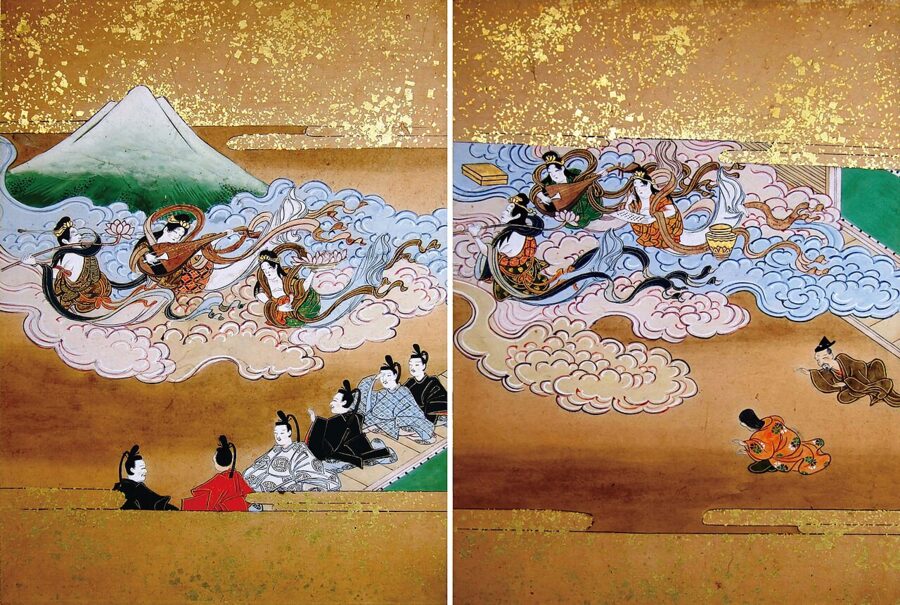
The most quoted origin story comes from the end of the Taketori Monogatari (竹取物語), the Tale of the Bamboo Cutter, written around the turn of the 10th century. Princess Kaguya returns to the moon and leaves the emperor an elixir of immortality. He has no wish to live for ever without her, so he orders it burned on the highest mountain, the one nearest heaven, and its smoke still rises.
The tale then names the mountain itself: it was called fuji because a great many soldiers, tsuwamono-domo amata, climbed it with the elixir. That is a pun on 富士, “rich in warriors”. Generations of readers have heard a second pun in it, 不死, “deathless”, for the elixir that burned there. Both are wordplay on a name that already existed; neither is an etymology.
The Ainu fire theory, and why it wobbles
The best-known modern theory came from the missionary John Batchelor, who worked among the Ainu of Hokkaido. He linked Fuji to an Ainu word for fire and read the whole name as “fire-spouting mountain”. It suits a volcano so well that English guidebooks still print it as fact.
It is not settled. Critics answered that Batchelor had taken huchi from Apehuchi Kamuy, the old woman of the fire who lives in the Ainu hearth; huchi means grandmother, not fire. Other proposals reach for Malay, Maori and proto-Polynesian roots, and one Japanese theory derives fuji from an old word for a long sloping hillside. Japanese dictionaries print the Ainu idea as one theory among several, and I would leave it there.
Why it is Fujisan, and why not Fujiyama
The -san on the end is not the polite -san added to people’s names. It is the Chinese-derived reading of 山, mountain, a first-grade character on the kyōiku kanji list. Japanese mountain names mix readings freely, by local habit rather than rule: Hakusan, Tateyama, Asahidake, Iwakisan.
“Fujiyama”, with the native reading yama, is often called a foreigner’s mistake. That is only half true. Japanese dictionaries do list ふじやま and fuji no yama as names for the mountain, and old poems use them; what you will not hear is a Japanese speaker calling it Fujiyama in conversation today.
The volcano: four mountains in one cone
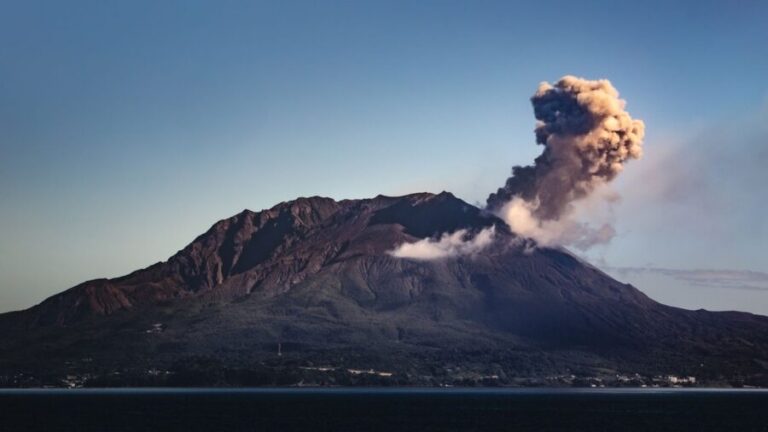
Fuji is a stratovolcano, built in layers of lava and ash, and it is younger and more complicated than its tidy outline suggests. The Japan Meteorological Agency describes a cone about 50 km across at the base and around 400 km³ in volume, with roughly a hundred side vents on its flanks.
Geologists count four. The oldest, Sen-Komitake, was only found in 2004, by a University of Tokyo borehole. Komitake itself peeps out near the Fifth Station on the Yamanashi side, where a small shrine of the same name stands. Ko-Fuji, Old Fuji, grew from about 80,000 years ago, and Shin-Fuji, New Fuji, has been burying it for roughly the last 10,000 years.
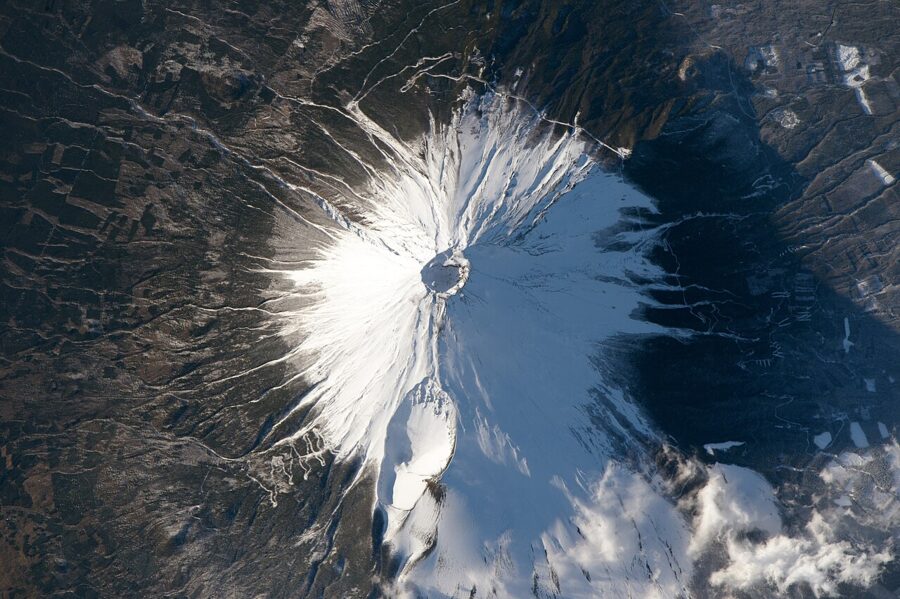
Its height is a schoolroom number. Surveyors fixed 3,776 m in 1926, and children remember it with a pun, mi-na-na-mu, the syllables for 3, 7, 7 and 6. The survey marker at Kengamine sits a little lower, under 3,775.6 m, so the figure everyone quotes belongs to the bare rock beside it.
Written records of eruptions begin in 781, and there are about ten in the histories. The large flank eruption of 864, the Jōgan eruption, poured out the lava that now carries the Aokigahara forest and split an old lake into Lake Sai and Lake Shōji. The Fuji Five Lakes are all, in one way or another, water held back by Fuji’s lava.
The Hōei eruption of 1707
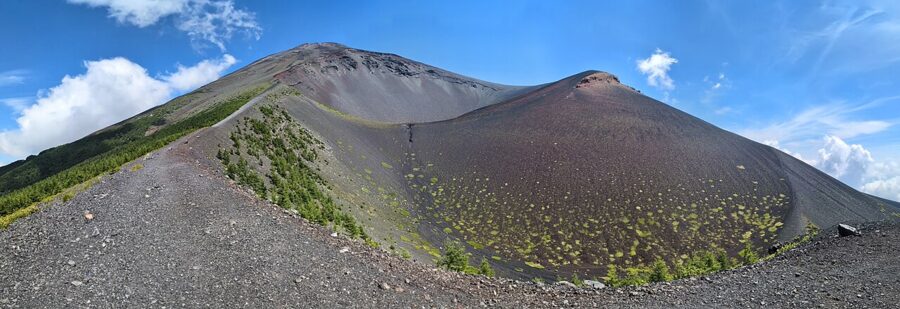
The last eruption began on 16 December 1707, the 23rd day of the 11th month of Hōei 4, only 49 days after one of the largest earthquakes in Japan’s recorded history. It did not come from the summit. A new crater tore open on the south-east flank and threw out pumice, then black basaltic ash, for about two weeks.
The ash blew east onto Edo, now Tokyo, about 100 km away. The scholar-official Arai Hakuseki wrote that lamps had to be lit at midday; ash fell on the city for more than ten days, a few centimetres of it, and the grit stirred up afterwards brought a wave of coughing sickness. Villages at the foot were buried far deeper.
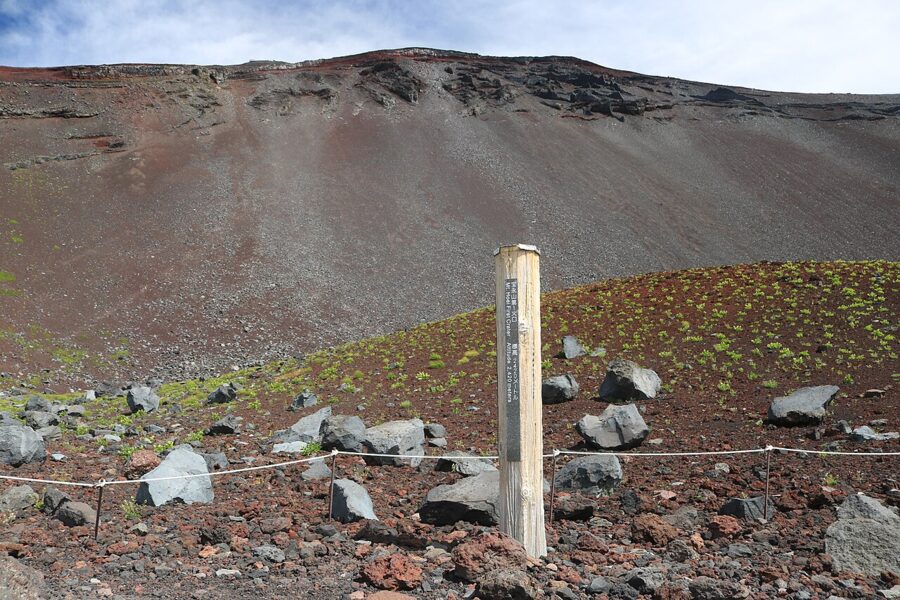
The eruption also left a new peak, Mount Hōei, 2,693 m, the bump that spoils Fuji’s symmetry when you see it from the south-east. Nothing has erupted since. That long quiet is why older Japanese textbooks called Fuji a dormant volcano; the category has since been dropped, and Fuji is on the agency’s list of active volcanoes under constant watch.
Will it erupt again? The hazard maps
Volcanologists expect it to; nobody can say when. After swarms of deep, low-frequency earthquakes under the mountain in 2000 and 2001, the national government and the two prefectures drew up the first full Fuji hazard map in 2004. A council of the national and local governments then revised it in March 2021, and the revision made the danger look larger.
- The record behind it now reaches back 5,600 years instead of 3,200, covering about 180 eruptions, 96% of them small or medium.
- Possible vents now include the whole area within 4 km of the summit, where old craters may lie buried.
- The largest lava flow modelled grew from 700 million to 1.3 billion cubic metres, after the Jōgan eruption was re-measured.
The result is that lava could reach some towns sooner and travel further down the big river valleys than the 2004 map showed. The evacuation plans for the area around the mountain have been revised to match.
The sacred mountain
Long before anyone climbed Fuji for the view, people prayed to it to stay quiet. After the eruptions of the 9th century, the court sent offerings to the god of the mountain, Asama no Ōkami, and the word asama or sengen (浅間) attached itself to the shrines built to calm it.
Sengen shrines and Konohanasakuya-hime
Over time the mountain’s spirit became a goddess, Konohanasakuya-hime (木花之佐久夜毘売), the princess of the flowering trees, daughter of the mountain god Ōyamatsumi. Earlier, some identified the goddess with Kaguya of the bamboo-cutter tale before Konohanasakuya-hime settled into the role. Both choices rest on the same old belief that a mountain’s deity is female.
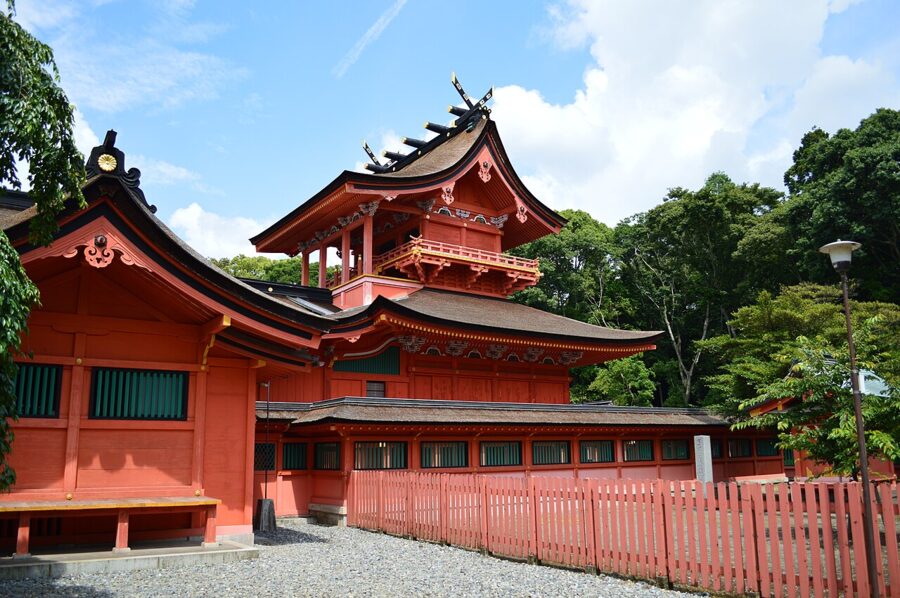
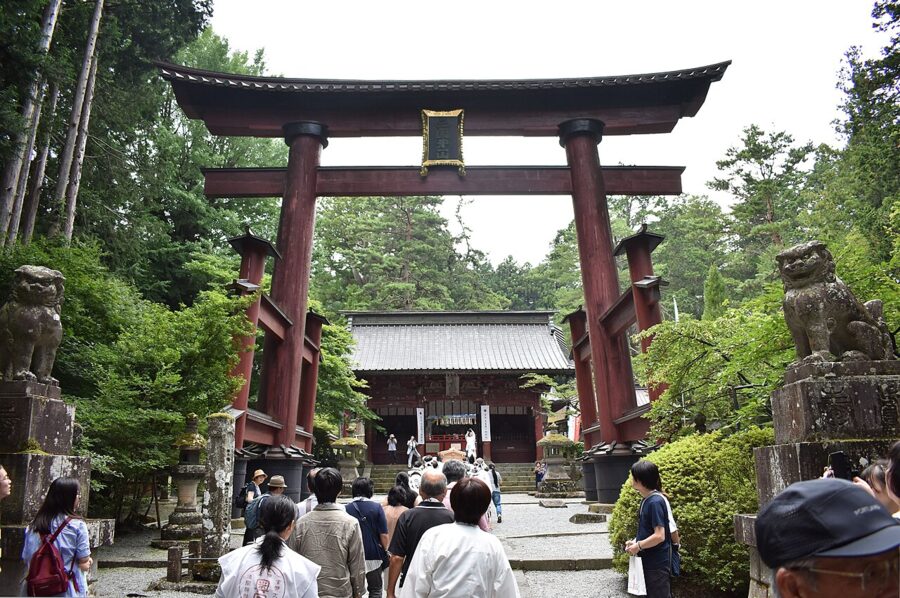
The head shrine is Fujisan Hongū Sengen Taisha in Fujinomiya, at the southern foot. Its dictionary entry gives its sacred body as the mountain itself from the Eighth Station up, and the shrine has a branch, the Okumiya, on the summit. Around 1,300 Sengen shrines across Japan, most of them in the east, trace themselves to it.
Fuji-ko pilgrims and the mini-Fujis of Edo
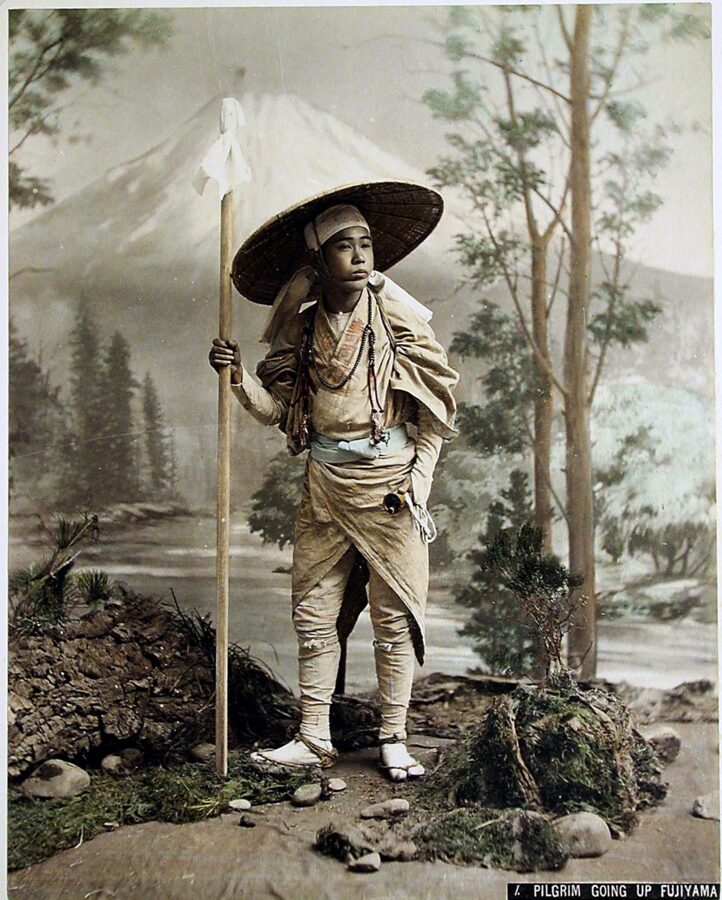
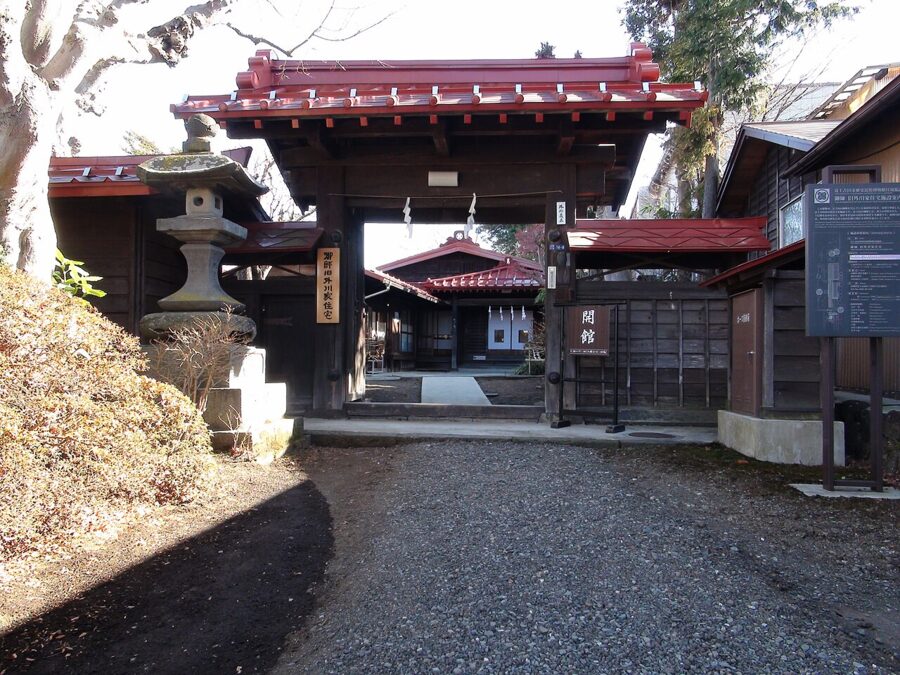
Mountain ascetics had climbed Fuji since at least the 12th century; a monk called Matsudai built a temple on the summit in 1149. The mass pilgrimage came later, through the Fuji-kō (富士講), lay confraternities that grew from the teachings of the ascetic Hasegawa Kakugyō. Their great organiser, Jikigyō Miroku, fasted to death in meditation on the mountain in 1733, and his followers spread through Edo so fast that people spoke of “Edo’s 808 kō”.
Each summer a party climbed in white, with staffs and bells, chanting rokkon shōjō (六根清浄), “purify the six senses”. At the foot they lodged with oshi (御師), priest-innkeepers who fed them, prayed with them and guided them. Women were barred from the upper mountain until the ban was lifted in 1872.
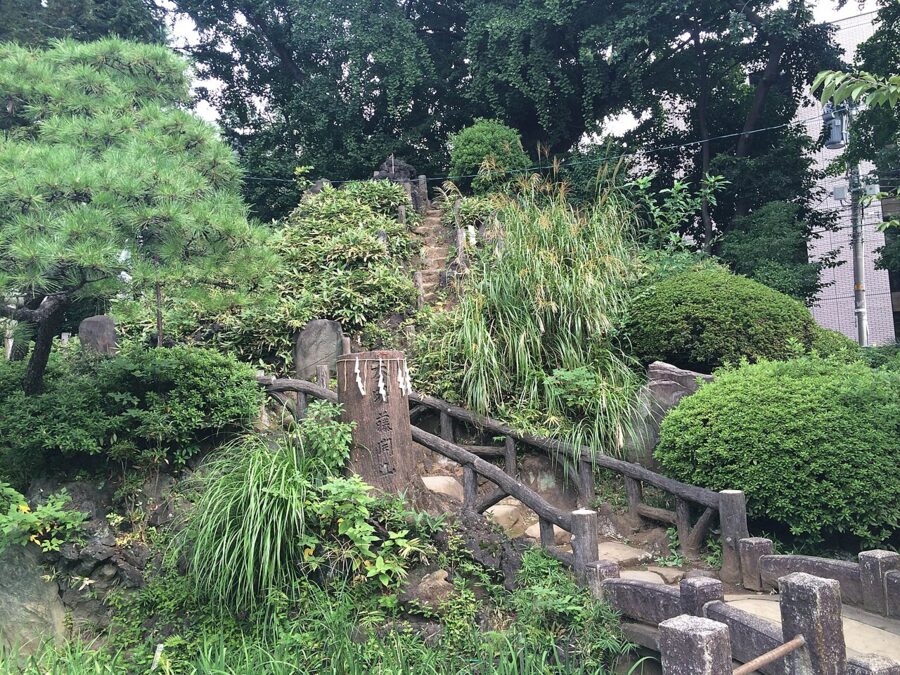
Not everyone could make the trip, so the kō brought Fuji to Edo. A fujizuka (富士塚) is a model Fuji, a mound of earth faced with black lava carried from the real mountain, with a shrine on top. Dictionaries date the fashion to the Bunka and Bunsei eras, 1804 to 1830, and dozens survive in and around Tokyo, several still holding their own mountain-opening each summer.
The 2013 UNESCO listing, and why it is cultural
On 22 June 2013 the World Heritage Committee inscribed Fujisan, sacred place and source of artistic inspiration. The Japanese title is the same idea, 富士山: 信仰の対象と芸術の源泉, “object of worship and source of art”. It was listed under two cultural criteria, for a living tradition of mountain worship and for its influence on art, including Western art through the prints.
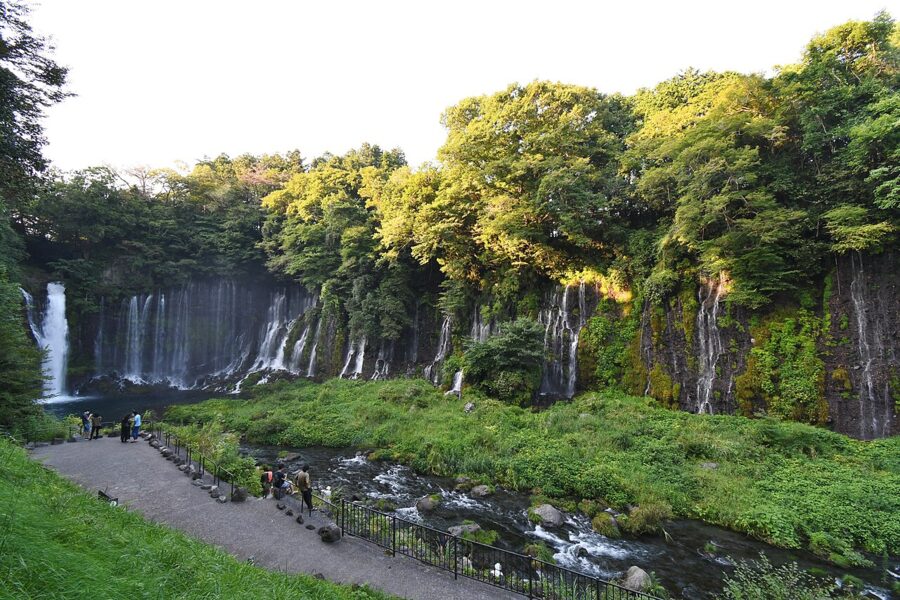
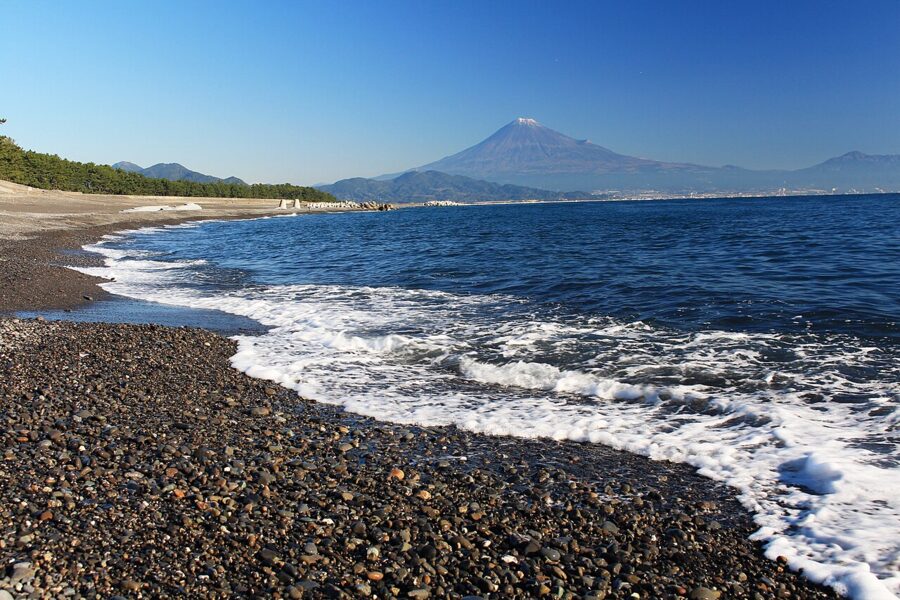
That is why the listing is not one mountain but 25 places. Beside the upper mountain it takes in the Sengen shrines, oshi houses, lava tree moulds, the Fuji Five Lakes, the Oshino Hakkai springs, the Shiraito Falls and the pine beach of Miho no Matsubara, 45 km away. Pilgrims bathed in the lakes and springs before climbing, which is how a waterfall becomes a cultural site.
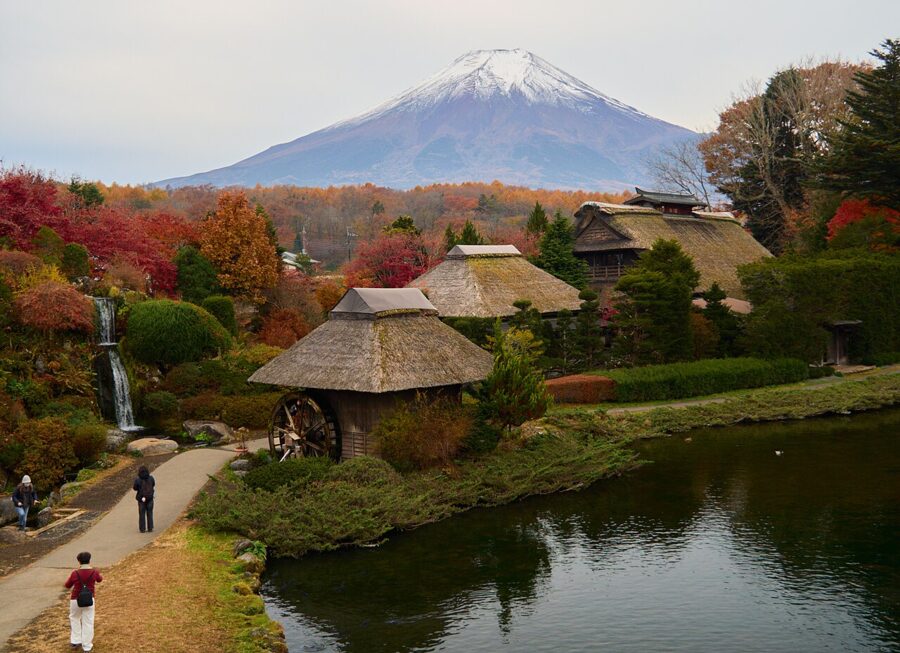
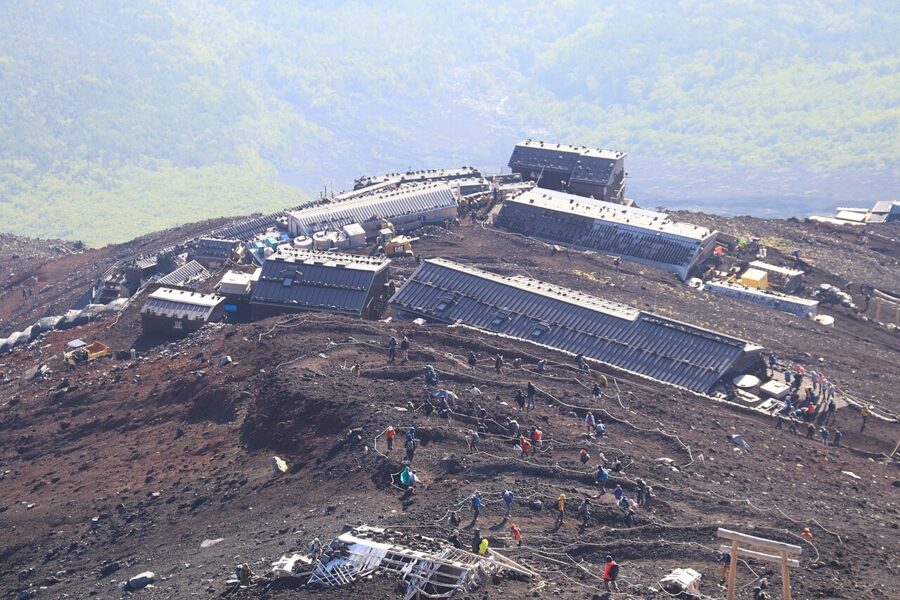
The listing came with homework. UNESCO’s statement worries openly about crowds on the upper trails, the huts and bulldozer tracks that serve them, and building around the lakes. Much of what has changed on the climbing trails since then answers that worry.
Fuji in prints, poems and pockets
Fuji was a stock image in poetry from the Man’yōshū on, and in painting from the 11th century. But the Fuji the world knows was fixed in the 1830s by a publisher in Edo and an artist in his seventies.
Hokusai’s thirty-six, and ten more
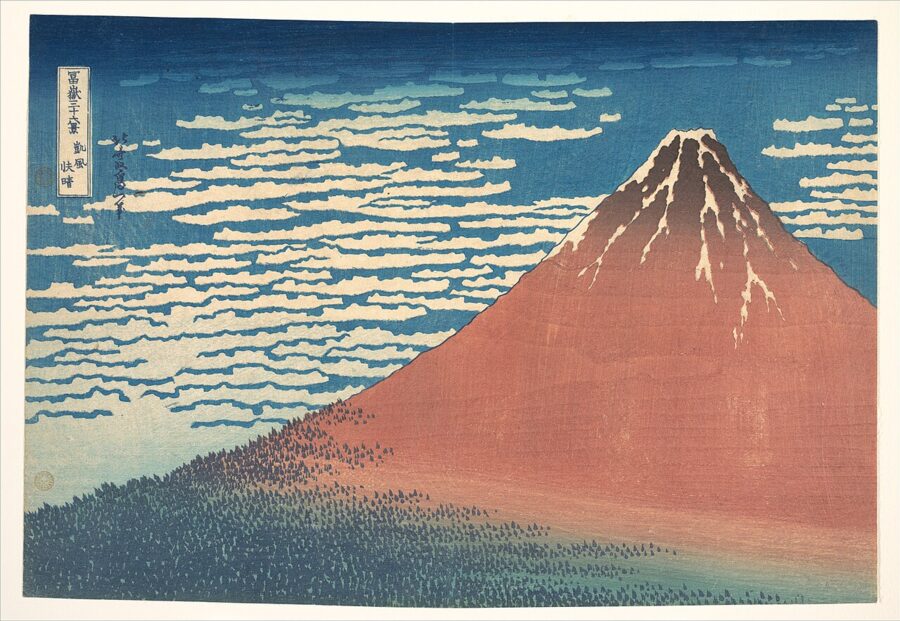
Katsushika Hokusai’s Fugaku sanjūrokkei (冨嶽三十六景), Thirty-six Views of Mount Fuji, came out around 1830 to 1832. It sold well enough that ten more prints were added, so the thirty-six are really forty-six. The series leaned hard on a new imported pigment, Prussian blue, and on a new idea: Fuji not as the subject but as the fixed point in other people’s lives.
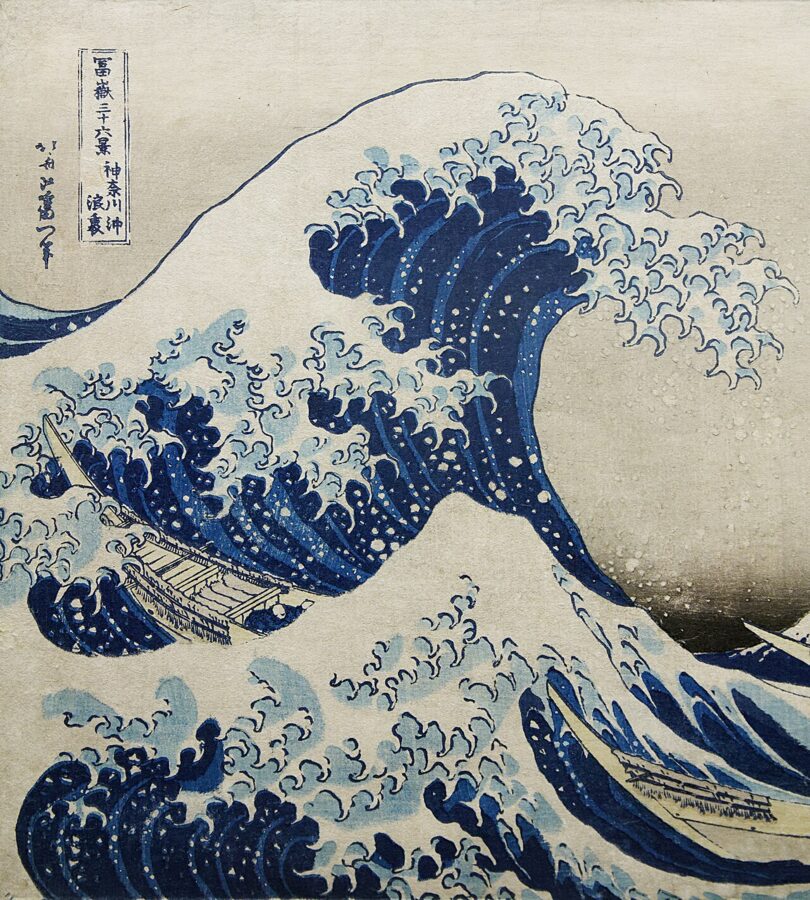
In the Great Wave the mountain is a speck in the trough. In Gaifū kaisei (凱風快晴), “south wind, clear morning”, it fills the sheet, a rust-red cone under a mackerel sky. Its nickname is akafuji, red Fuji, which is also what Japanese poets call the real thing.
Hiroshige’s Fuji
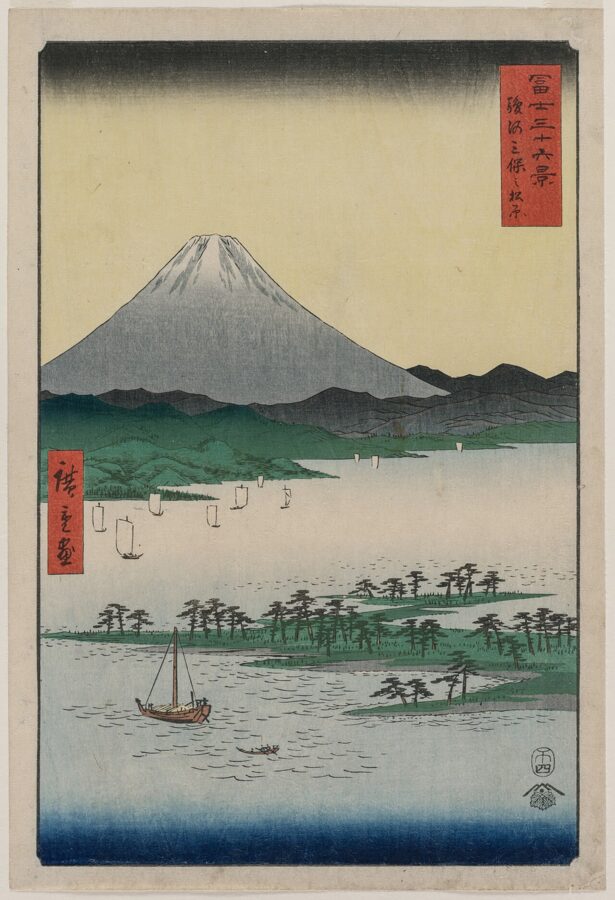
Utagawa Hiroshige put Fuji into many of his series, from the Tōkaidō road stations onwards, and in the year of his death, 1858, designed his own Fuji sanjūrokkei, published the next year. His Fuji is taller, the prints are upright, and the places are ones he had sketched on his travels. Where Hokusai plays games with scale, Hiroshige reports the view.
Fuji on the ¥1,000 note
Most people in Japan carry Fuji around without looking at it. The Bank of Japan describes the back of the 2004 ¥1,000 note (about $6), the one with the bacteriologist Noguchi Hideyo on the front, as Fuji and cherry blossoms; the view is from the shore of Lake Motosu, with the mountain doubled in the water. Since 3 July 2024 the new ¥1,000 note, with Kitasato Shibasaburō, carries Hokusai’s Great Wave on the back instead. Both notes are legal tender.
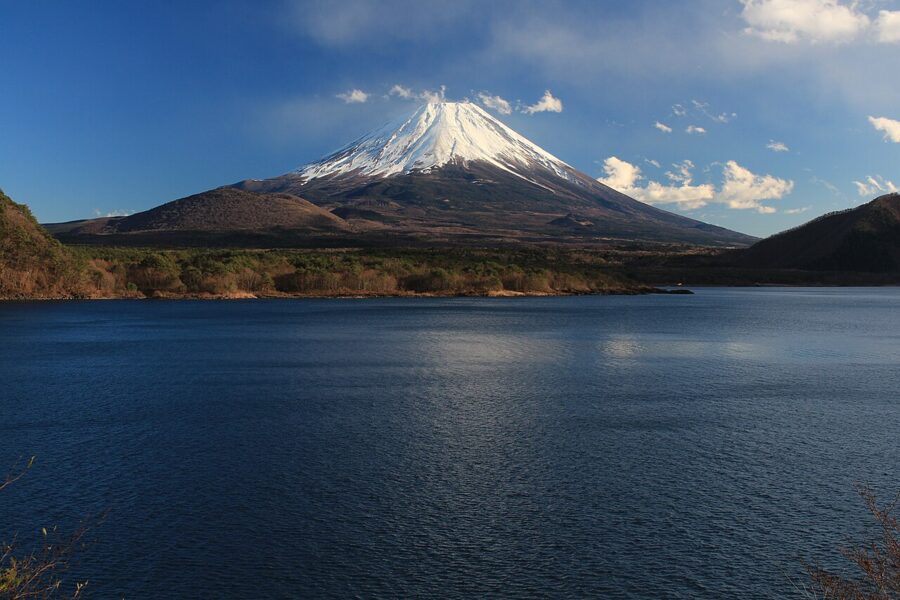
Season words: akafuji, hatsufuji and Fuji-mode
Fuji has its own entries in the haiku almanacs, the lists of kigo (季語), season words, that tie a poem to a time of year. Akafuji is a summer word: early on clear mornings in late summer and early autumn, low sun and thin cloud turn the bare, snowless north face red. Hokusai painted the phenomenon; modern haiku poets put its name in the almanac.
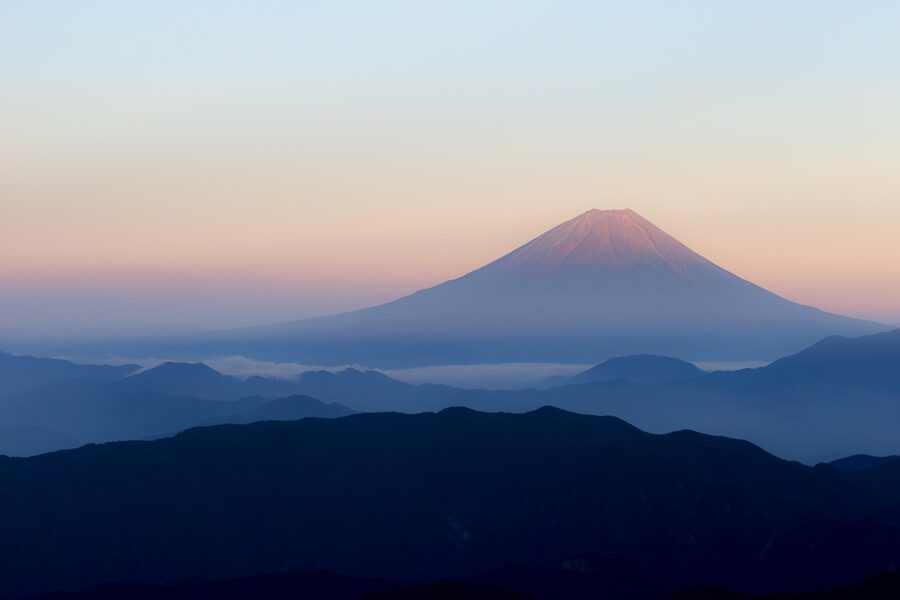
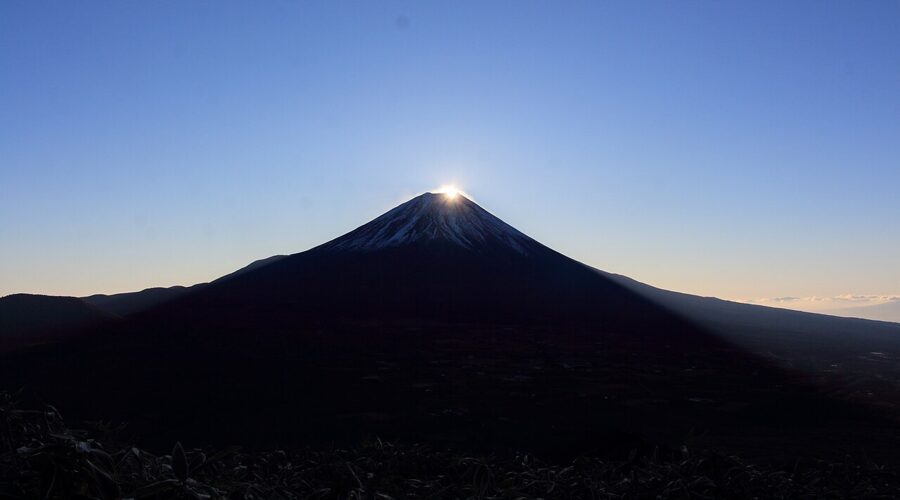
Hatsufuji (初富士), first Fuji, is a New Year word for the mountain seen on the morning of 1 January. Fuji-mōde (富士詣), the Fuji pilgrimage, and Fuji-kō itself are summer words, because the climb began on the first day of the sixth month of the old calendar. In Japan’s climate the best season for simply seeing the mountain is winter, when the dry wind clears the haze over Tokyo.
Climbing Fuji today
You can climb it. The Ministry of the Environment’s counters near the Eighth Station recorded about 240,000 climbers in the 2026 season, 17% more than in 2025. It is not a technical climb, but it is long, steep, cold at the top and high enough for altitude sickness, and Yamanashi gives a standard time of about six hours up and four down on its trail.
The trails open only in summer. For 2026 the official climbing site listed these dates; the 2027 season is expected from early July to early September, with exact dates announced before it opens.
| Trail | Prefecture | Starts at | Open in 2026 |
|---|---|---|---|
| Yoshida | Yamanashi | Fuji Subaru Line Fifth Station, about 2,300 m | 1 July to 10 September |
| Subashiri | Shizuoka | Subashiri Fifth Station, about 2,000 m | 1 July to 10 September |
| Fujinomiya | Shizuoka | Fujinomiya Fifth Station, about 2,400 m | 10 July to 10 September |
| Gotemba | Shizuoka | Gotemba New Fifth Station, about 1,440 m | 10 July to 10 September |
The fees and rules since 2024
For years the only charge was a voluntary conservation donation. That changed in 2024, when Yamanashi turned the upper Yoshida trail into a prefectural path with a ¥2,000 fee (about $13), a limit of 4,000 climbers a day and a gate shut overnight, aimed at dangan tozan (弾丸登山), “bullet climbing”, the all-night dash to the summit without rest. In 2025 the fee rose to ¥4,000 and Shizuoka brought in its own rules for its three trails.
As of the 2026 season the rules stood like this:
- Yoshida trail (Yamanashi’s rules): ¥4,000 per person per climb; no more than 4,000 climbers a day, hut guests aside; the Fifth Station gate closed from 2 pm to 3 am except to climbers with a hut booking; staff check for warm clothing, two-piece rain gear and proper boots. Only climbers who booked ahead got the commemorative wooden tag.
- Fujinomiya, Subashiri and Gotemba (Shizuoka’s rules): ¥4,000 entry fee; a short online course on safety and conservation before you get your entry pass; a hut booking if you set off between 2 pm and 3 am. Shizuoka sets no daily cap.
From 2026 Yamanashi also stopped charging walkers who use only the old lower section, from Umagaeshi up to the Fifth Station gate, which is how the Fuji-kō climbed. Neither prefecture has yet announced its 2027 rules.
The words around the mountain
Fuji runs through ordinary Japanese far beyond the mountain. The Fuji Goko (富士五湖), the Fuji Five Lakes, are Yamanaka, Kawaguchi, Sai, Shōji and Motosu, all on the north side. Fujimi (富士見), Fuji-view, names streets, slopes and whole towns, among them Fujimi in Saitama and Fujimi in Nagano, both named for their view of the peak.
Any shapely cone elsewhere becomes a local Fuji. There are at least 340 of these kyōdo Fuji (郷土富士), home-town Fujis, from Ezo Fuji in Hokkaido to Satsuma Fuji in Kagoshima, and the islands have their own, such as Rishiri-Fuji rising out of the sea.
The mountain shows up in faces and dreams too. A Fuji-bitai (富士額), Fuji forehead, is a hairline that dips to a point in the middle, once counted a mark of beauty. And the luckiest first dream of the year is said to be ichi Fuji, ni taka, san nasubi: Fuji, then a hawk, then an aubergine. The ranking turns up among Japan’s lucky symbols, and it is one of the New Year traditions people still joke about.
Where to see it
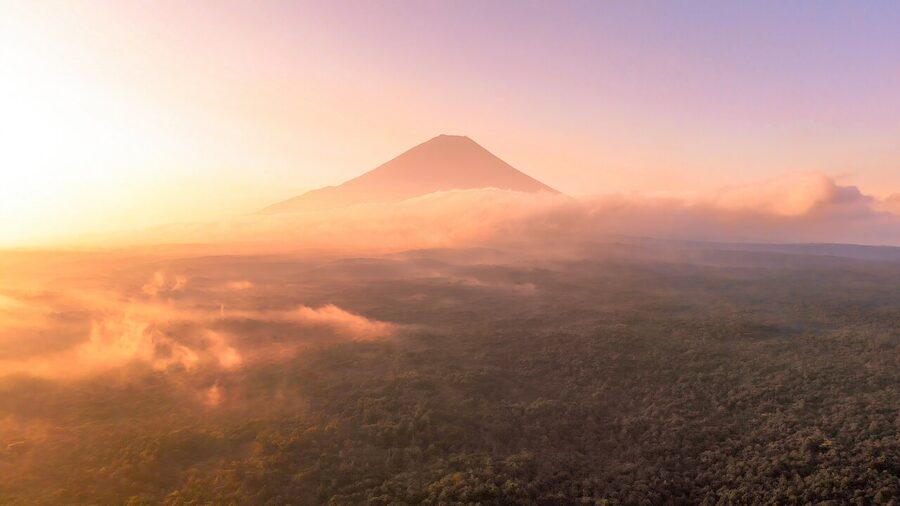
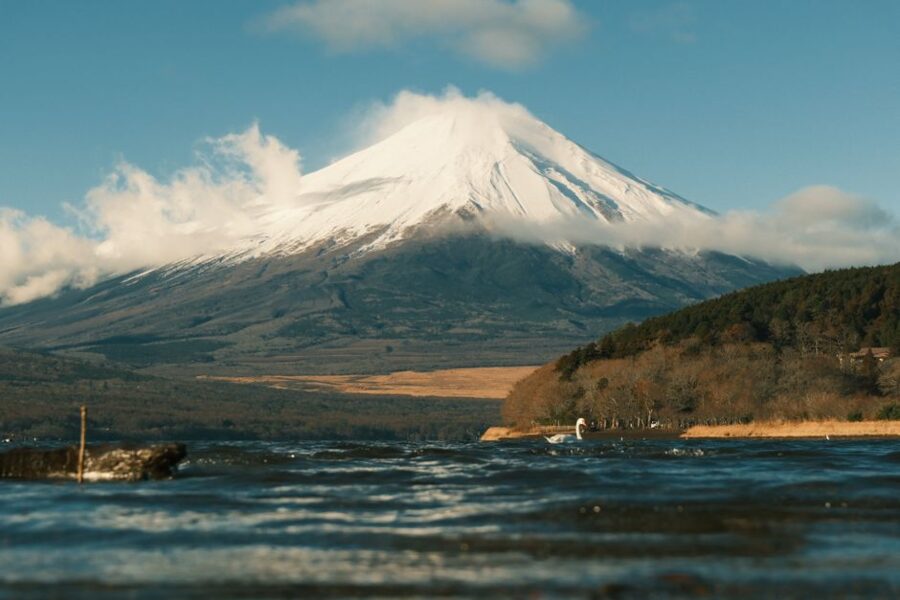
Fuji is shy. Cloud and haze hide it on many summer days, and the clearest views come on cold mornings from late autumn to early spring. Three places give the pictures everyone knows.
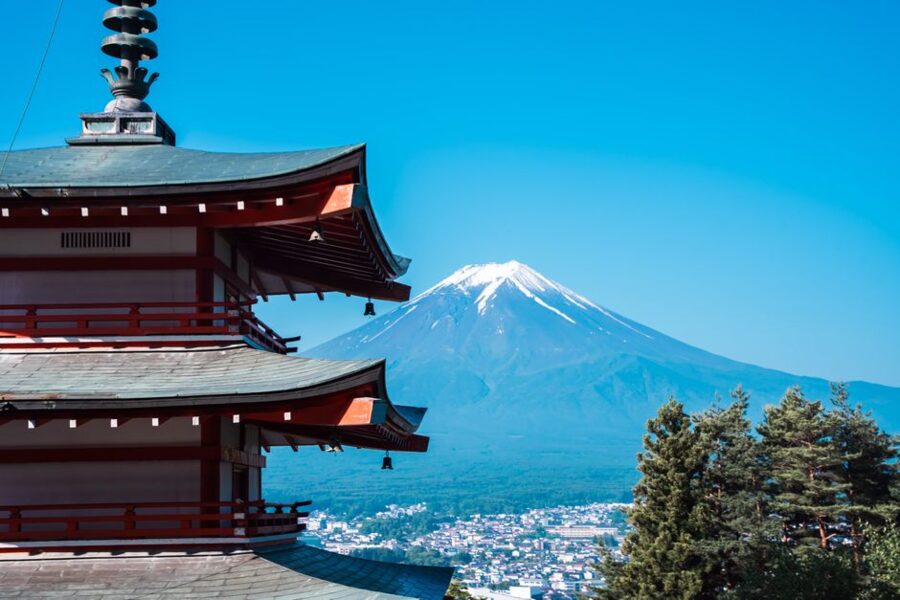
Chureito Pagoda, Fujiyoshida. The red five-storey pagoda stands on the hillside of Arakurayama Sengen Park, up a long flight of steps from Shimoyoshida station on the Fujikyu line. Its name, chūreitō (忠霊塔), means a memorial tower for the war dead. In April, with cherry blossoms in front and snow on the peak, it is the most photographed Fuji view there is, and the crowds show it.
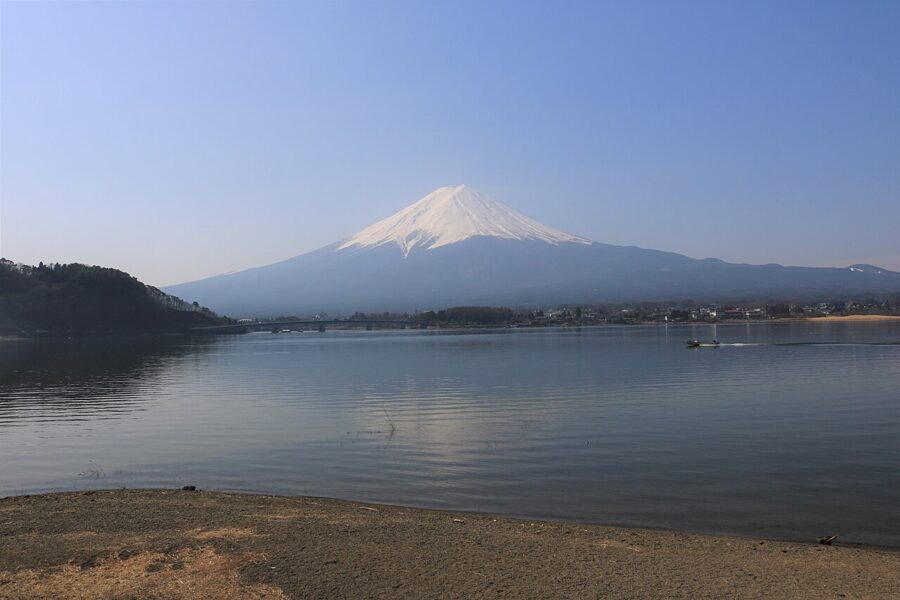
Lake Kawaguchi. The north shore gives the cone straight across the water, with Kawaguchiko station a bus ride away. Lake Motosu, further west, gives the banknote view and the best chance of a reflection.
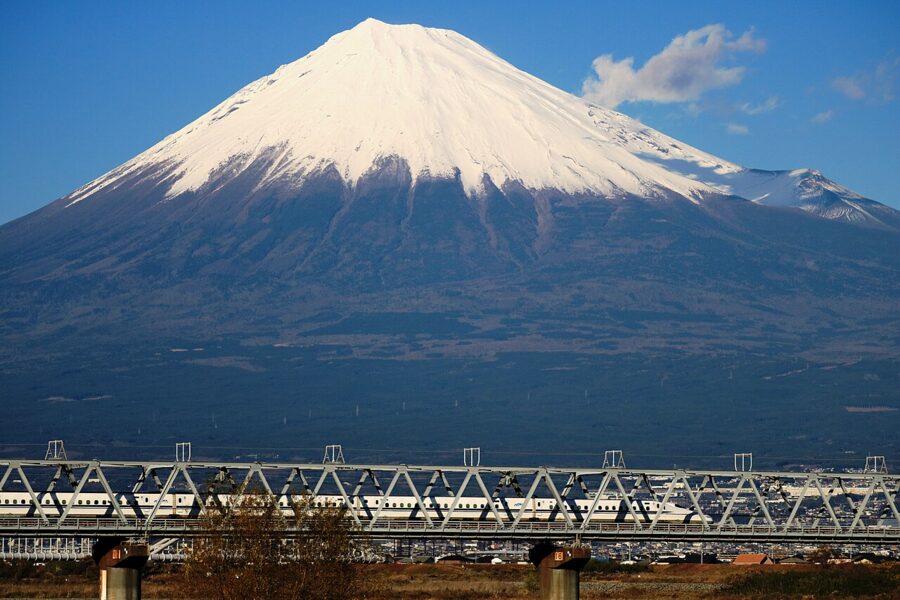
The Shinkansen. On the Tōkaidō Shinkansen, book seat E, the window on the mountain side; the seat letters stay on the same side of the car whichever way the train runs. The mountain fills the window for a few minutes around Shin-Fuji station, where the line crosses the Fuji River.
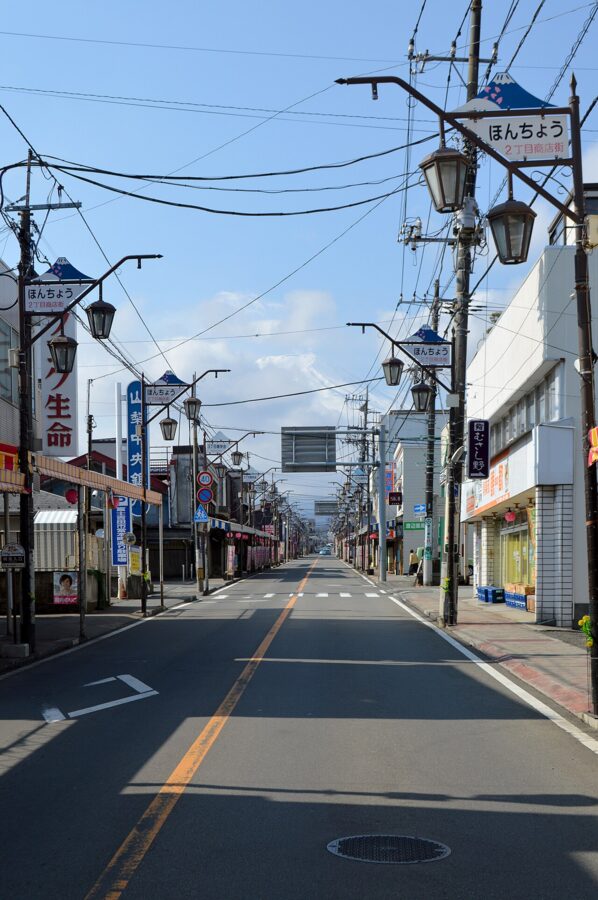
From Tokyo itself, look west from any high floor on a clear winter morning; the old Fujimi-zaka slopes were named for exactly that. When the cone comes out over the rooftops, read its name again. The 山 is the only part anyone can vouch for; the 富士 is a thousand years of guesses, and it has worn them well.