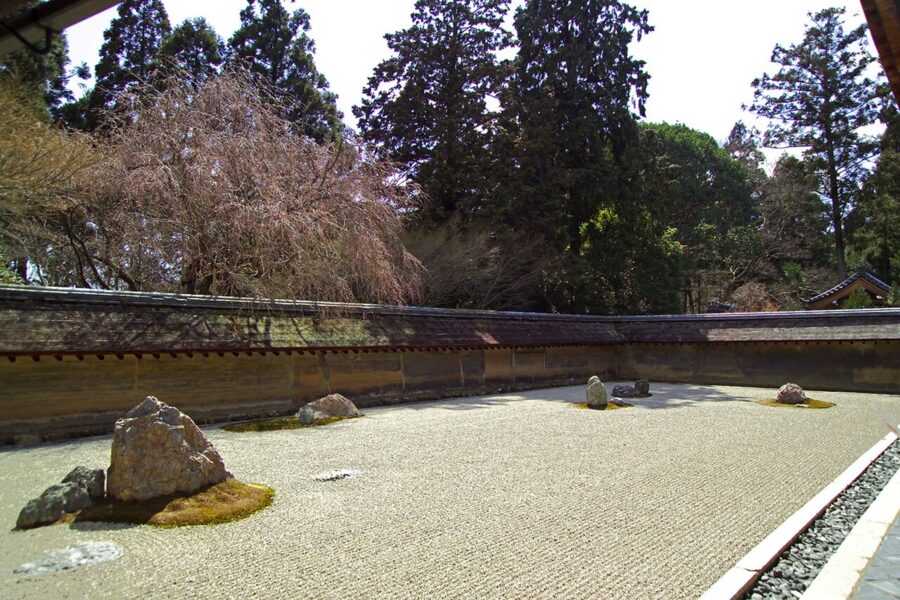
Fifteen stones, a rectangle of raked white gravel 25 metres by 10, and an old clay wall: Kyoto’s best-known rock garden is a pond with the water taken out. Japanese has a word for that kind of garden, karesansui (枯山水), and it reads like an inventory. 枯 is withered or dried up, 山 is mountain, 水 is water.
Most of the vocabulary of the Japanese garden works the same way. The three kinds you will meet are named either for what they are made of or for what you do in them: the dry garden, the pond garden you walk round, and the dewy ground that leads to a tea room. Learn a dozen of them and a garden starts to read like a sentence.
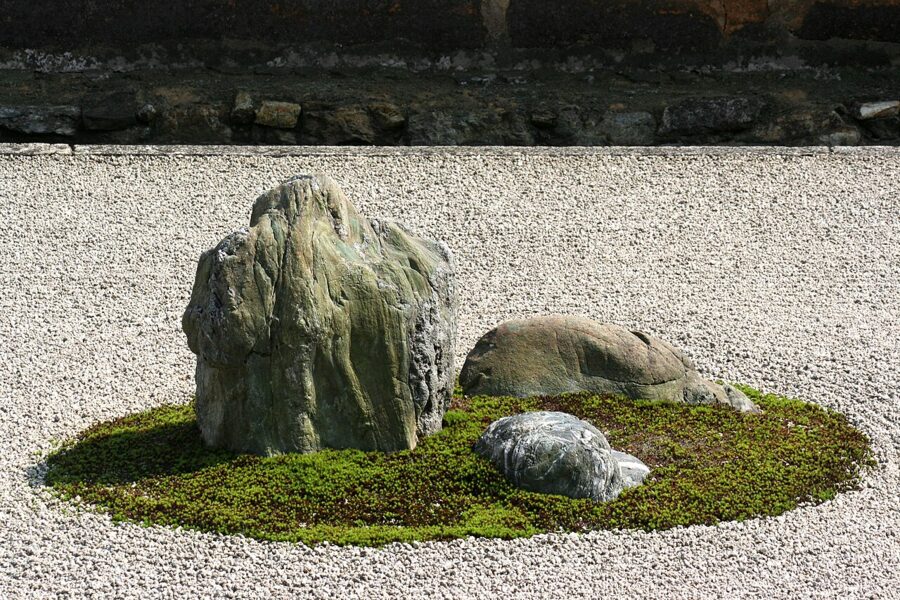
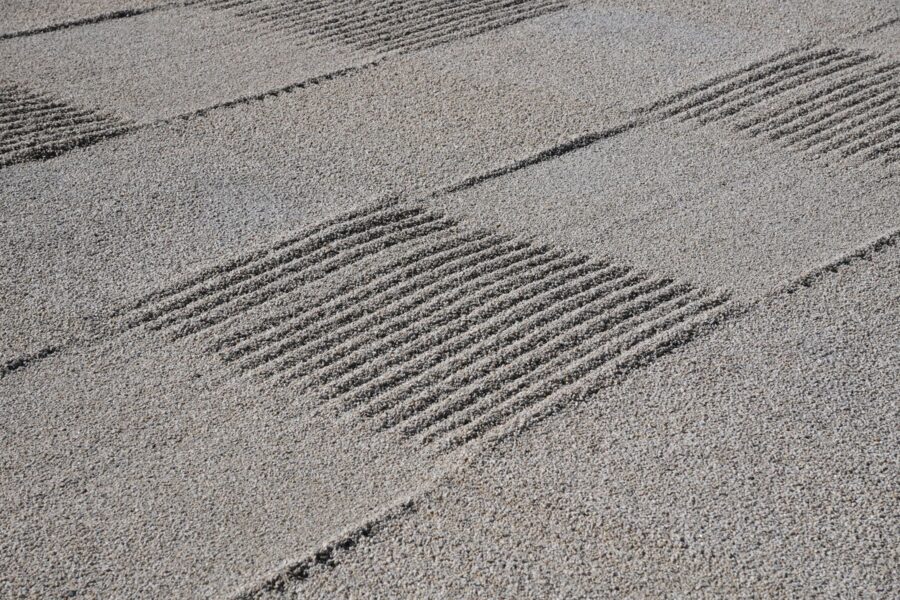
At Ryōan-ji the gravel is the water. Its raked lines run straight across the open ground and bend into rings round each stone group, the way a current wraps a rock.
In this article
- 庭 and 庭園: from a place for work to a garden
- The Sakuteiki, the oldest garden manual
- Karesansui: dry mountain water
- Chisen kaiyū: the pond garden you walk round
- Shakkei: borrowed scenery
- Roji: the dewy ground to the tea room
- Lanterns, deer scarers and other garden words
- The people behind the words
- A short glossary of garden terms
- Where to see each kind
庭 and 庭園: from a place for work to a garden
The native word niwa (庭) did not start as a garden. The Nihon Kokugo Daijiten gives its first sense as a place where something is done: hunting, farming, a rite. A poem in the Man’yōshū even calls a stretch of calm sea the fishermen’s niwa, their place of work. One proposed origin is ni, earth, plus ha, place, offered as one theory among several.
The old sense survives in 校庭, a school sports ground, and in older houses the beaten-earth work floor inside the front door was also a niwa. Only later did the word narrow to planted ground with a hill and a pond.
Teien (庭園), the formal word you will see on every ticket booth, is much younger than the gardens it names. Heibonsha’s encyclopedia says the compound of 庭, open ground, and 園, enclosed planted ground, settled into use in the 1890s; the Nipponica puts it around 1907, as a translation of “garden”. Ryōan-ji’s stones are four centuries older than the word.
The Sakuteiki, the oldest garden manual
The first person to write garden rules down was a courtier, not a monk. The Sakuteiki (作庭記), “record of garden making”, is credited to Tachibana no Toshitsuna (1028–1094), son of the regent Fujiwara no Yorimichi, who built the Byōdō-in. Toshitsuna’s family name, Tachibana, is one of the four great clan names of the Heian court, which is why it turns up in any history of Japanese surnames.
The title is an Edo-period label, fixed when the anthology Gunsho ruijū printed the text. The oldest copy, a pair of Kamakura-period scrolls now an Important Cultural Property, has no title, and earlier readers knew it as Senzai hishō (前栽秘抄), secret notes on gardens. A note in it is dated Shōō 2 (1289), one of the era names that date Japanese documents.
The first line sets the tone:
石をたてん事、まづ大旨をこゝろうべき也
In setting stones, first grasp the overall idea.
It tells you to take natural scenery as your model and to set each stone “following the request of the stone” (in modern Japanese, 石の乞わんに従って), a phrase that comes back six times. It is my favourite rule because it is practical: the first stone decides where the second goes, as one word limits the next. The book also names the dry garden for the first time: “there are places with no pond and no stream where stones are set; this is called karesansui“. In Toshitsuna’s day that meant a rock group on a slope at the edge of a pond garden, not a whole courtyard.
Karesansui: dry mountain water
The word describes a picture. 山水, mountains and water, also means a painted view; put 枯 in front and the water has withered away. Stones stand for mountains, islands and waterfalls, and raked gravel or sand for the water.
The style grew up in Zen temples in the 15th century. Japanese dictionaries of the term tie it to ink paintings of mountains and water brought from Song and Ming China, to the small walled courts beside abbots’ quarters, and to the plain fact that water was hard to bring into them. Much of the work was done by kawaramono (河原者), “riverbank people”, labourers at the bottom of medieval society; Zen’ami, who worked for the shogun Ashikaga Yoshimasa, is the best known.
Ryōan-ji: fifteen stones and no explanation
Temple tradition dates the garden to around 1499, when the abbot’s hall was raised. Everything else is argument: who set the stones, what they mean, whether the date holds. Two names are cut into one of the long stones by the wall, read as Kotarō and something-jirō, and they are the only signatures the garden has.
Nicknames fill the gap: the “tiger cubs crossing” garden, after a Chinese tale of a tigress ferrying three cubs over a river, and the “seven-five-three” garden. You will also read that no seat on the veranda shows all fifteen stones at once. Treat that as a story told about the garden, not a rule left by a maker who left none. In 1780 a Kyoto guidebook praised the temple’s pond for its mandarin ducks rather than its stones.
Daisen-in: a whole river in a corridor
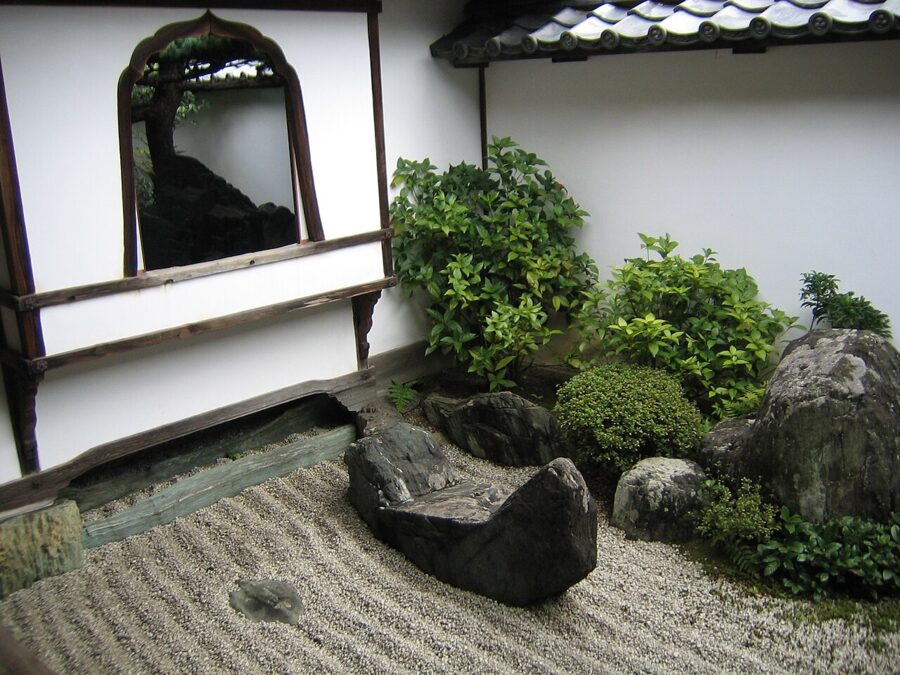
If Ryōan-ji is a sentence with most of the words left out, Daisen-in is a paragraph. This subtemple of Daitoku-ji was founded in 1509 by Kogaku Sōkō, who is credited with the garden wrapped round the north-east corner of its abbot’s hall. A dry waterfall drops from a mountain between a crane island and a turtle island, becomes a river of gravel, runs under a stone bridge and carries a boat-shaped stone to the sea.
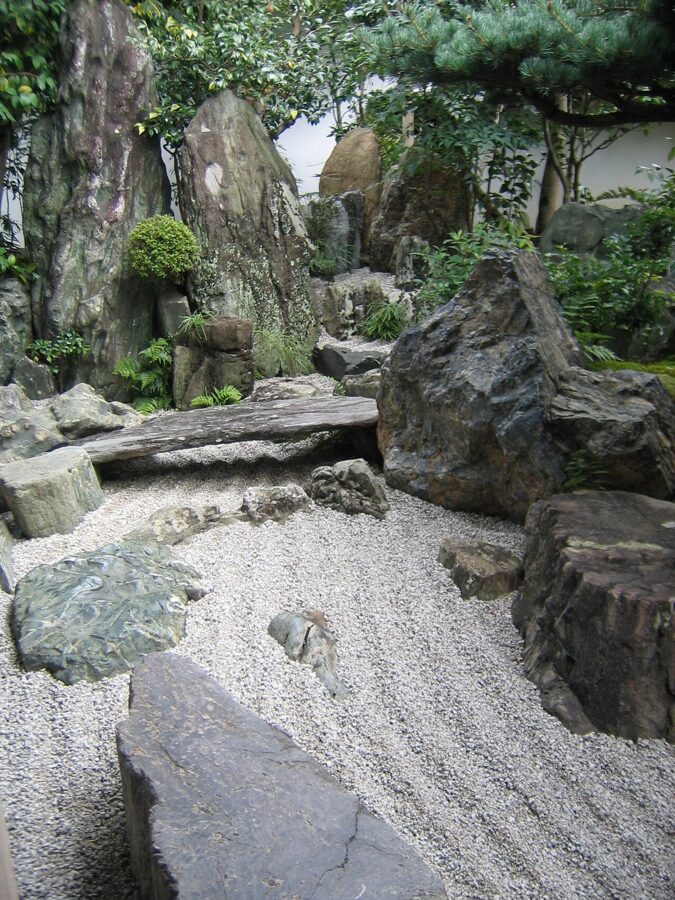
The sea is the south garden: raked white sand and two sand cones, nothing else. Where an ink painter shows distance with paler ink, the garden uses smaller, greyer stones. Daisen-in’s river garden and Ryōan-ji’s stones are both Special Places of Scenic Beauty (tokubetsu meishō, 特別名勝), the state’s highest garden designation.
Later dry gardens
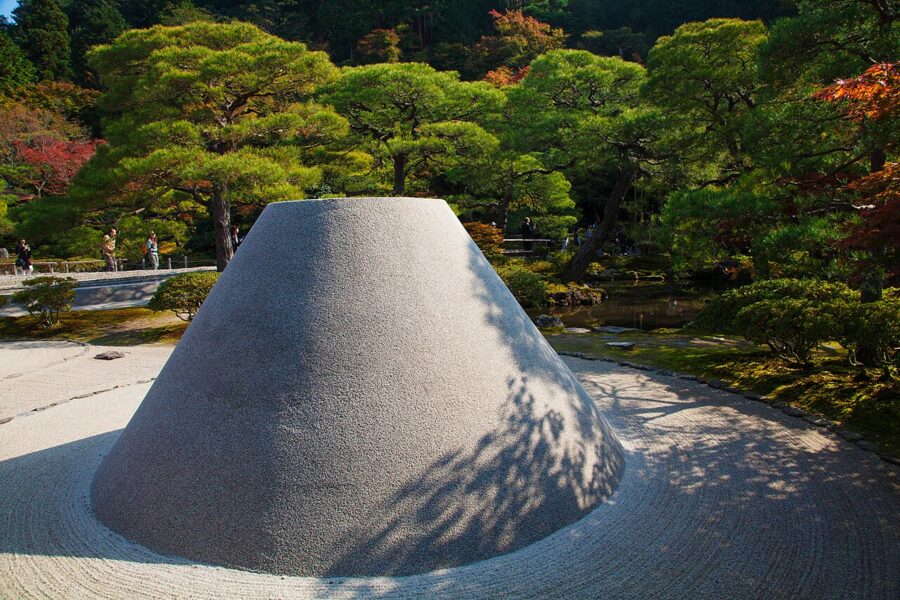
Once the idea existed, it travelled. At Ginkaku-ji, the Silver Pavilion, white sand is heaped into a wide raked bed, the ginshadan (銀沙灘), “silver sand open sea”, and a flat-topped cone, the kōgetsudai (向月台), “platform facing the moon”. Both are thought to be later additions to Yoshimasa’s garden. Nobody knows for certain what the cone was for, and its likeness to Mount Fuji is the reading most visitors give it.
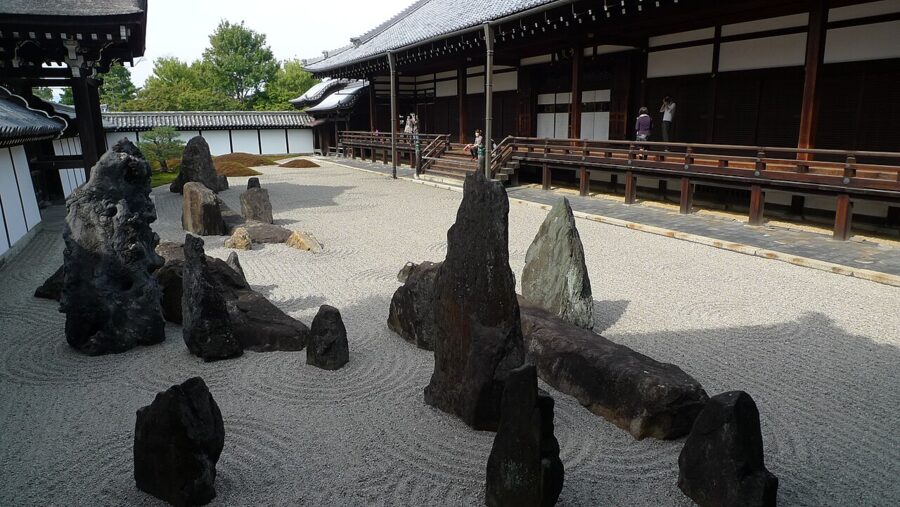
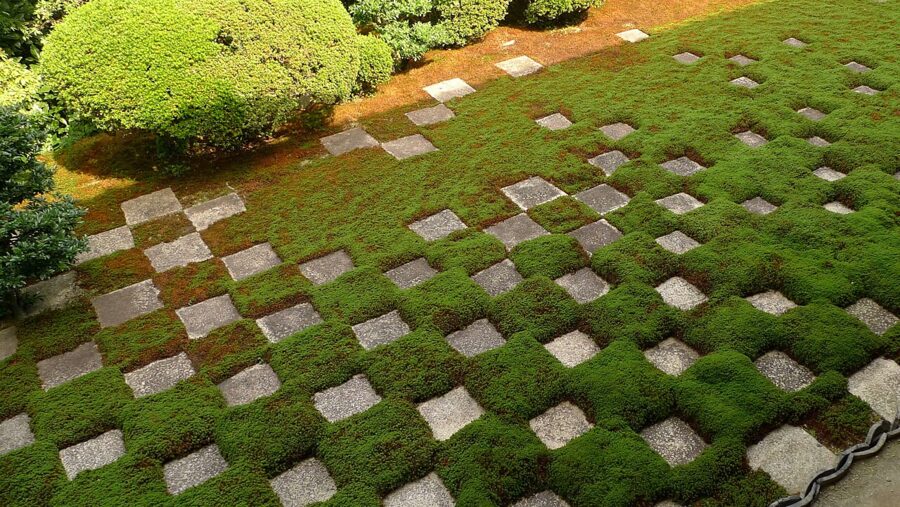
In 1939 Shigemori Mirei, who also surveyed hundreds of old gardens, laid out four round the abbot’s hall of Tōfuku-ji. They are 20th-century gardens built entirely out of the old vocabulary.
Chisen kaiyū: the pond garden you walk round
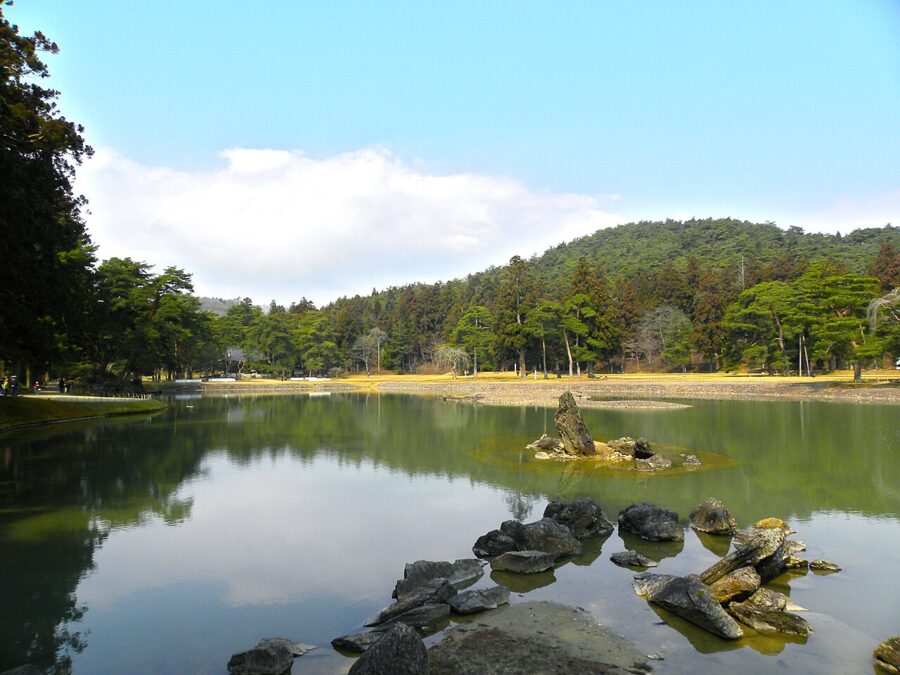
The second kind is named for what you do. Chisen kaiyū-shiki teien (池泉回遊式庭園) breaks into 池 pond, 泉 spring or stream, 回 round, 遊 to wander for pleasure, and 式 style. The Kenrokuen’s own guide sets it against zakan-shiki (座観式), the seated-viewing garden that you look at from a temple room, like Ryōan-ji. A pond garden is walked, and each turn of the path shows a new view and hides the last.
The form reached full size in the Edo period, when daimyo built gardens round a lake, with tea houses, bridges, islands for the immortals and copies of famous views. A tsukiyama (築山) is a built hill, 築 to build plus 山. A suhama (州浜) is a sandbar shore of pebbles curving into the water, an outline that also became a family crest among Japanese symbols.
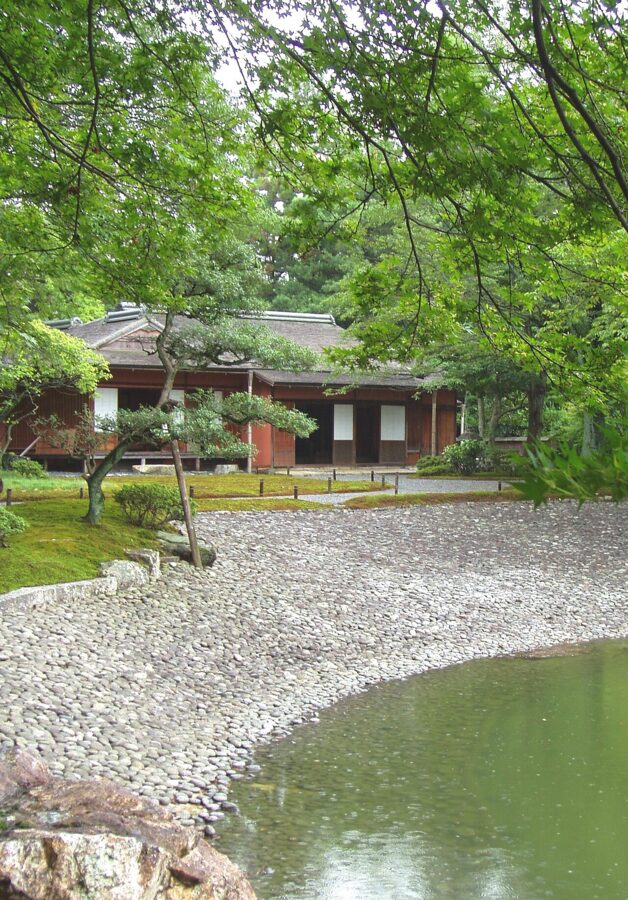
Katsura Imperial Villa
Katsura was built in the 17th century as a country house for the princes of the Hachijō-no-miya line, starting with Prince Toshihito (1579–1629). Its garden covers about 58,000 square metres of ponds, inlets and islands, with tea houses round the water. Tradition credits Kobori Enshū with the design; the documents do not, and the garden grew over two generations of princes.
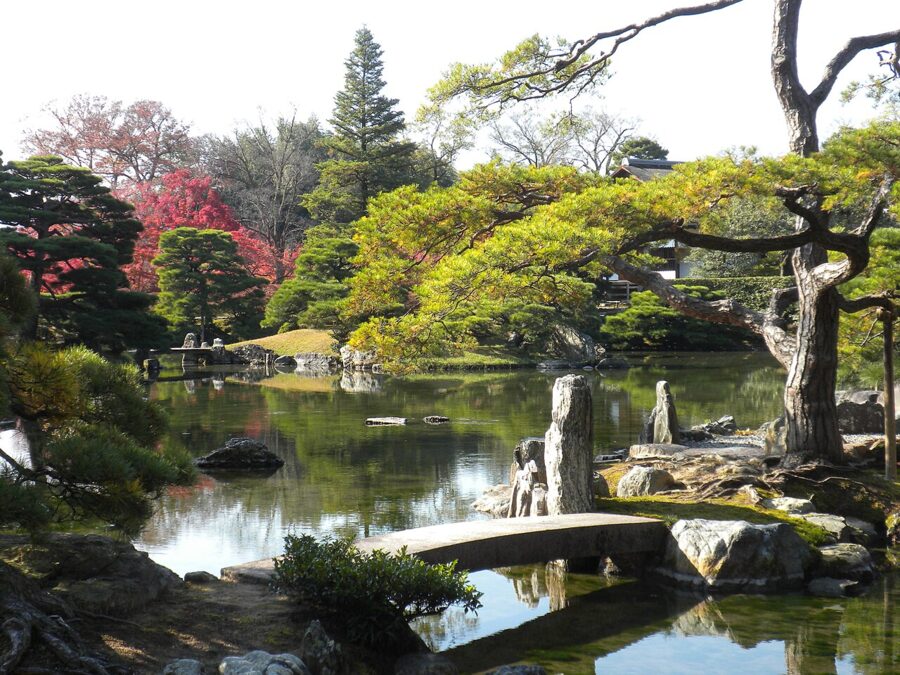
It also holds most garden vocabulary on one walk: a pebble suhama with a lantern at its tip, an outer waiting bench for tea guests, stepping stones, and a basin fed by a running stream in front of the Shōkintei tea house.
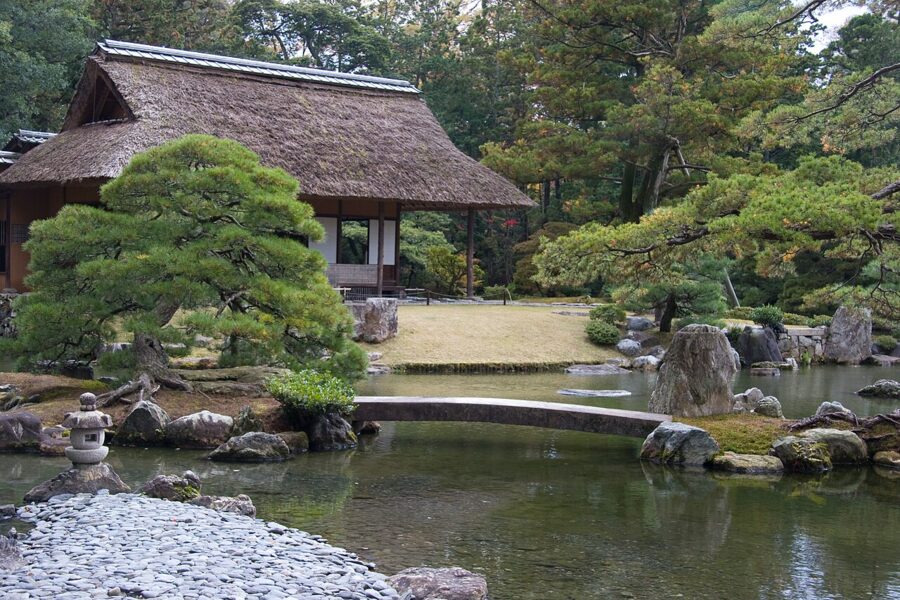
Katsura is seen only on an Imperial Household Agency guided tour of about 60 minutes. Junior and senior high school students go free and younger children cannot join. Online bookings open at 5:00 on the first of the month three months ahead, and a few same-day places are handed out from 8:40.
Kenrokuen, Kanazawa
The name is a list. 兼 to combine, 六 six, 園 garden: six qualities that rarely go together, spaciousness and seclusion, artifice and age, water and views. They come from a Song-dynasty account of the gardens of Luoyang, and the naming is usually credited to Matsudaira Sadanobu in 1822.
I am wary of that neat story. In his diary for 1822 Sadanobu writes that he was asked to brush the name board and sent to ask what “kenroku” meant, which suggests the name was already there.
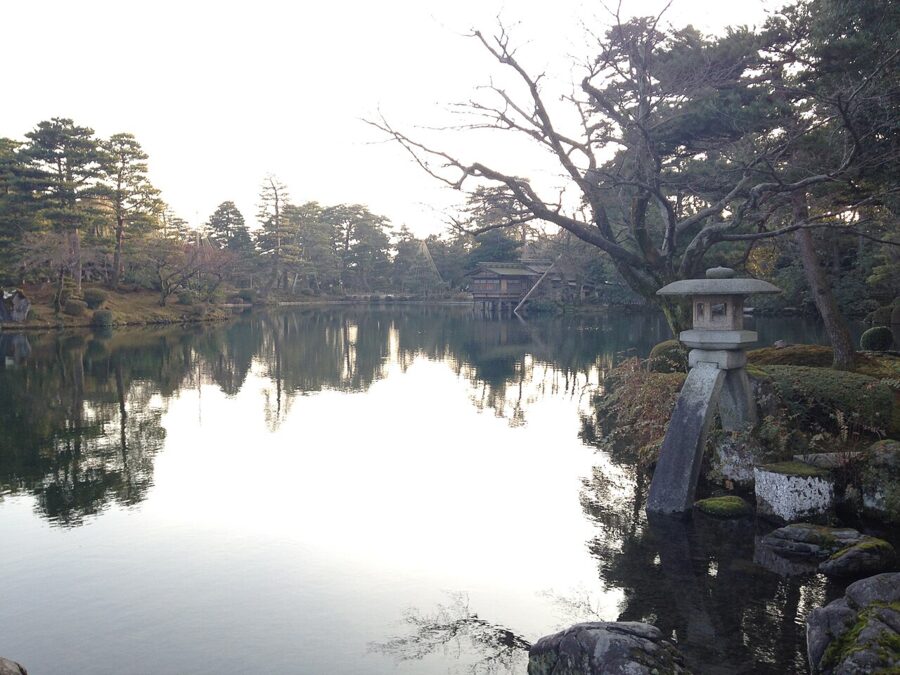
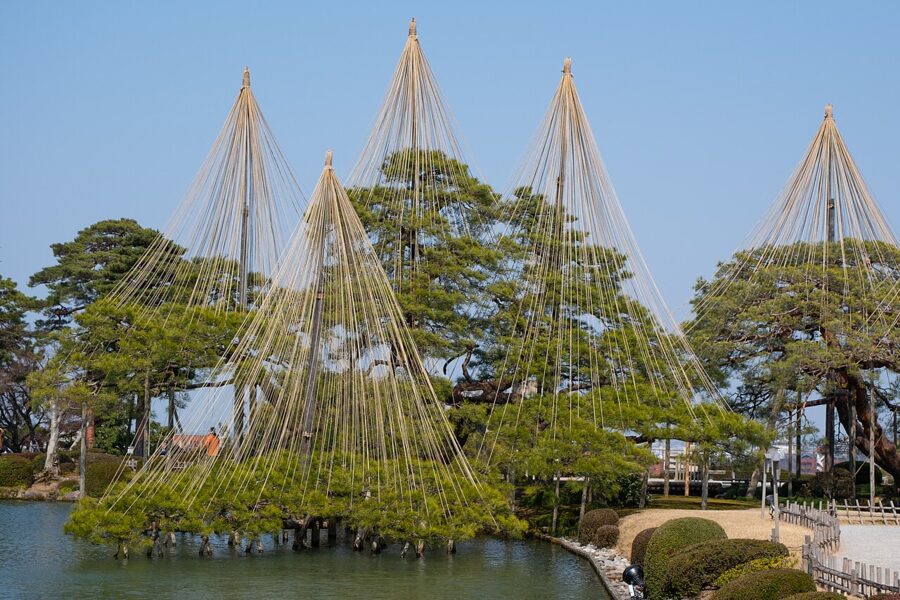
The Kenrokuen is one of the three gardens traditionally ranked Japan’s finest, with Kōrakuen in Okayama and Kairakuen in Mito. Each November its pines are tied with yukitsuri (雪吊り), “snow hanging”, ropes from a pole above the crown to each branch so wet snow cannot snap them: a garden dressed for the seasons and weather.
Ritsurin Garden, Takamatsu
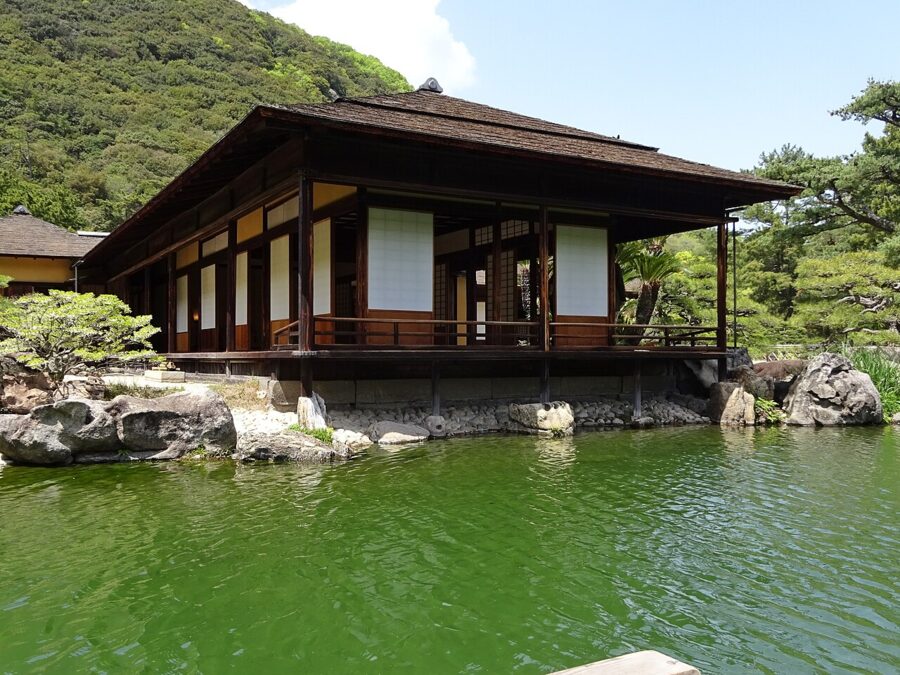
栗林 is chestnut grove, read the Chinese way as Ritsurin. The lords of Takamatsu built it over about a century; in 1745 the fifth lord named 60 views in it, and about 50 survive. Six ponds and 13 built hills lie at the foot of Mount Shiun, which the garden counts as part of itself, making about 75 hectares.
Shakkei: borrowed scenery
Shakkei (借景) is 借 to borrow and 景 view: a mountain, a forest or a pagoda outside the wall, taken into the garden’s picture. The word came from China, where a garden manual of the 1630s, the Yuanye (園冶), gave it a chapter; Japanese gardeners had borrowed views since the Heian period, most of all in the early Edo period.
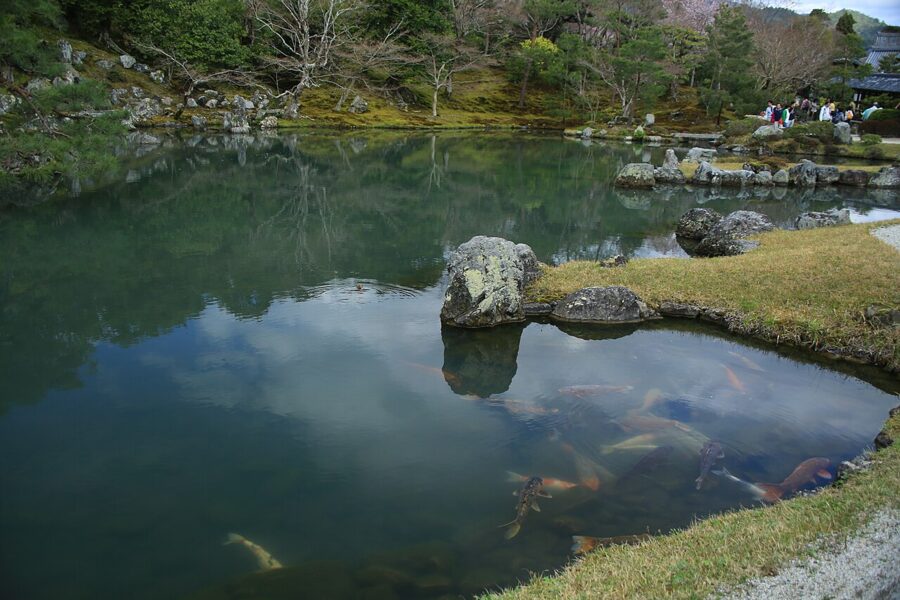
The trick is in the middle distance. A hedge or a wall hides the houses and roads between garden and mountain, so the eye jumps from the near pond straight to the far ridge. The classic pairs are Shūgakuin and Mount Hiei, Tenryū-ji and Arashiyama, and Entsū-ji, whose small garden of hedge and mossy stones frames Mount Hiei between the trunks of its trees. The cost is that when a borrowed view is built over, the garden loses part of itself.
Roji: the dewy ground to the tea room
The third kind is the garden you pass through on the way to tea. Its name, 露地, is dew plus ground, and English guides translate it “dewy ground”. The characters say that, but the meaning runs deeper. The Nihon Kokugo Daijiten gives 露地 as a Buddhist term from the Lotus Sutra: in its parable of the burning house, the children escape to open ground, and the open ground stands for a mind clear of worldly cares.
The path was first written with the everyday 路地, a lane. Edo-period tea writers, keen to give tea a Buddhist footing, switched to the scriptural characters, and the name stuck. “Dewy ground” is the letters; “the place beyond the burning house” is the sense.
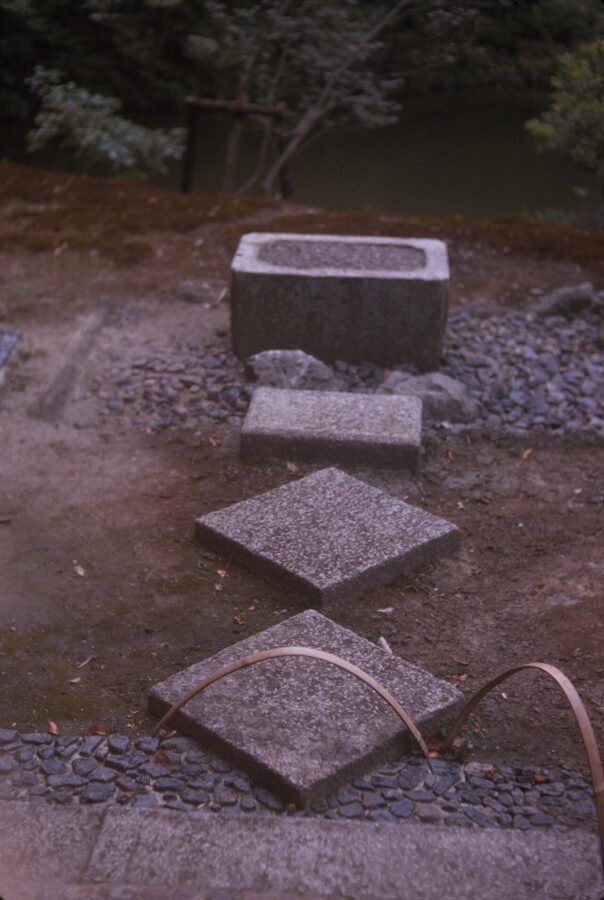
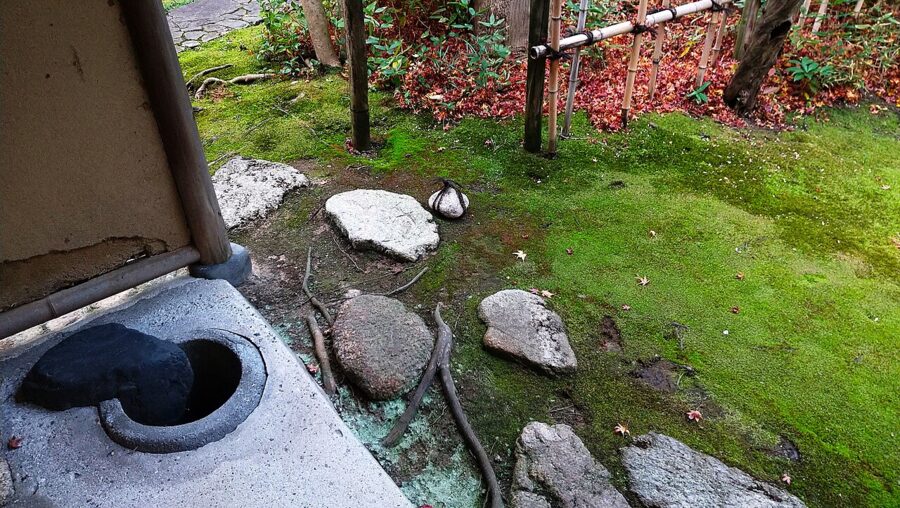
A roji usually has an outer and an inner part, divided by a middle gate. Guests wait on a covered bench, the koshikake machiai (腰掛待合), then walk the tobi-ishi (飛石), “flying stones”, the stepping stones that keep feet off the moss. Sen no Rikyū is said to have wanted them laid sixty parts for walking and forty for looks; his pupil Furuta Oribe reversed the ratio.
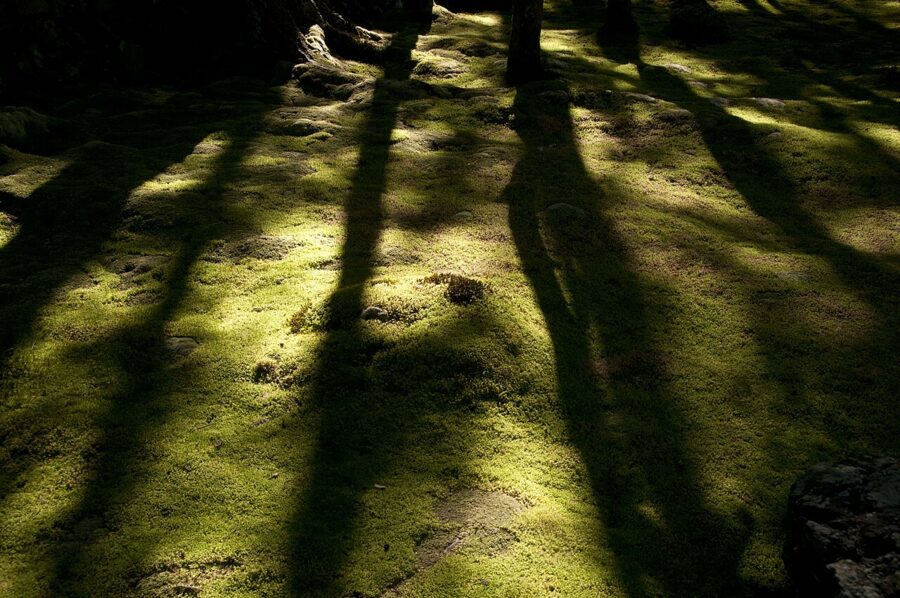
The tea of Rikyū’s circle aimed at shichū no sankyo (市中の山居), a mountain retreat in the middle of town, and its planting was plain evergreens rather than flowers. The moss and worn stone that people now call wabi-sabi are at home on these paths.
The tsukubai
Before entering, guests rinse their hands and mouth at a tsukubai (蹲踞), from tsukubau, to crouch. The basin is set low so you must bend to use it, the humble gesture tea asks for. Around it sit three named stones: a front stone to crouch on, a stone on one side for a hand lamp at evening gatherings, and one on the other for a pail of warm water in winter. The gravel hollow that catches the spilt water is called the umi, the sea.
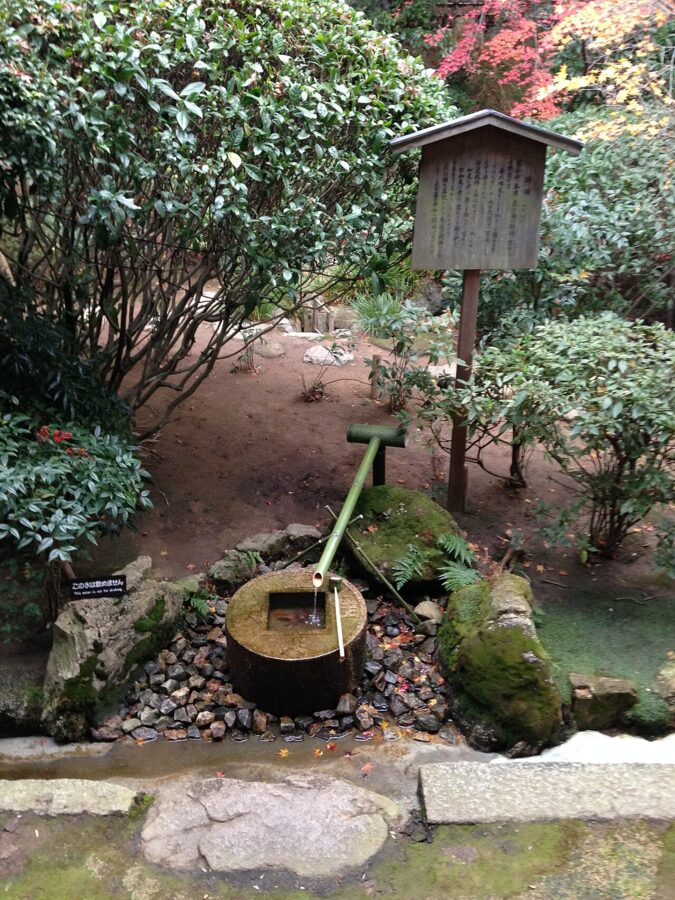
Ryōan-ji’s basin is the best-known word puzzle in any Japanese garden. The square hole supplies the 口 that turns four fragments into 吾, 唯, 足 and 知: ware tada taru wo shiru, “I only know contentment”. The original, said to be a gift of Tokugawa Mitsukuni, stands in the roji of the temple’s tea room.
Lanterns, deer scarers and other garden words
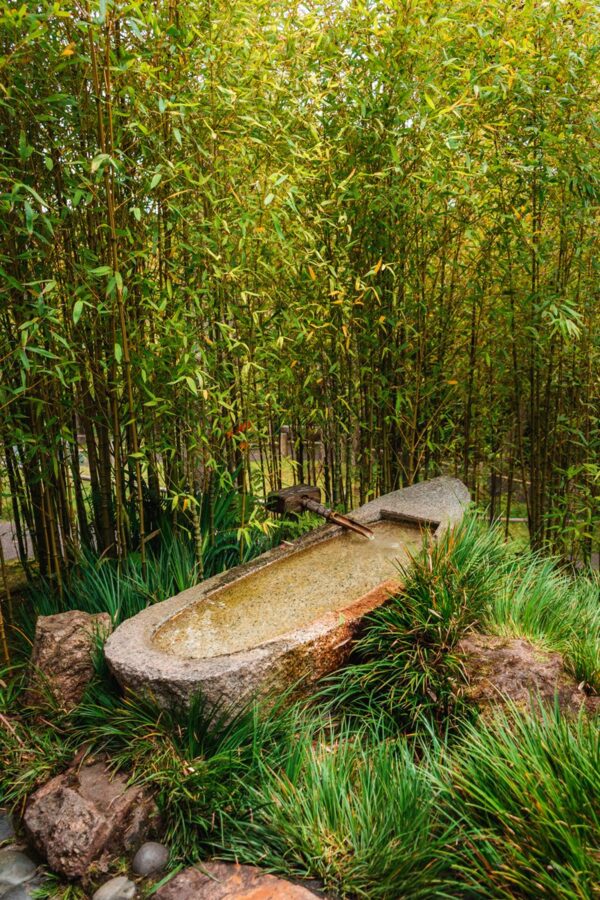
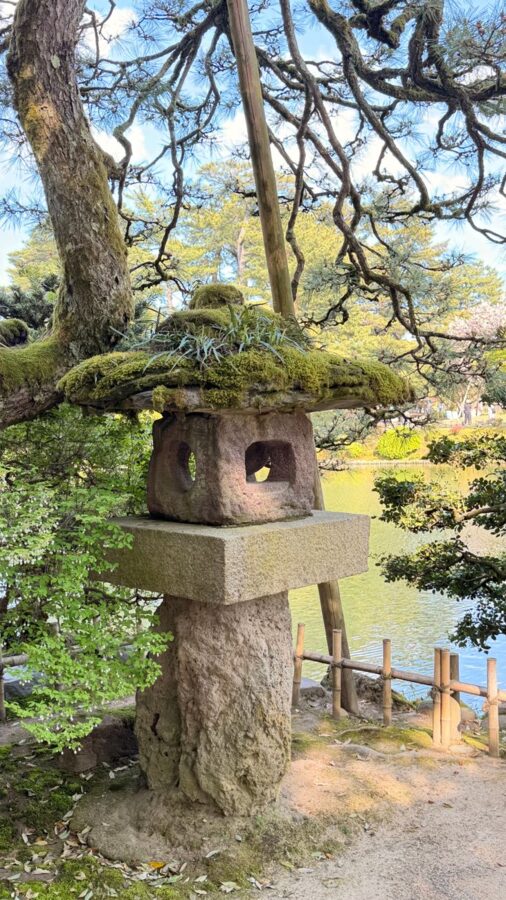
The tōrō (灯籠) is 灯 a light and 籠 a basket or cage. Stone lanterns came with Buddhism as lights offered before temple halls and moved into gardens later; in the roji they lit evening tea and the basin. Tea men liked them old and reused.
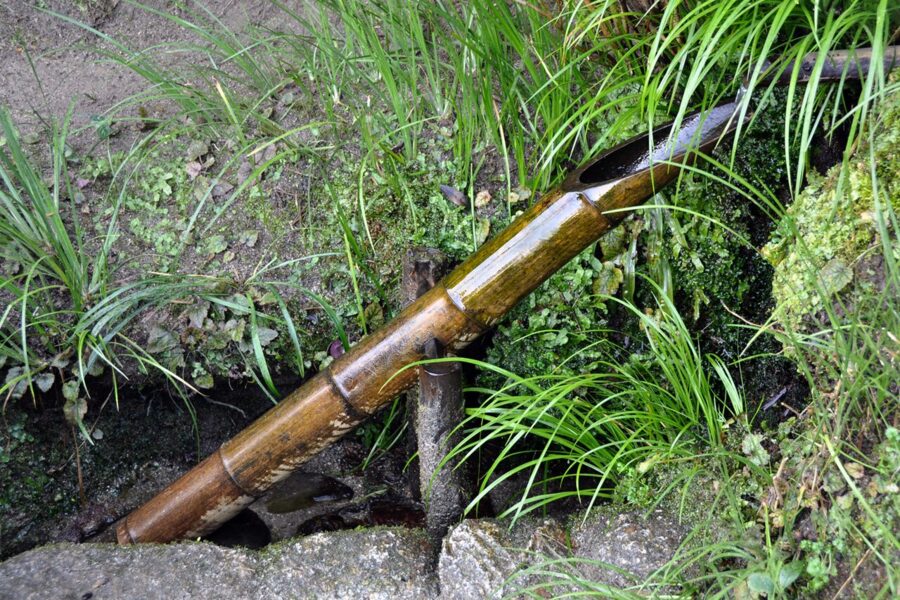
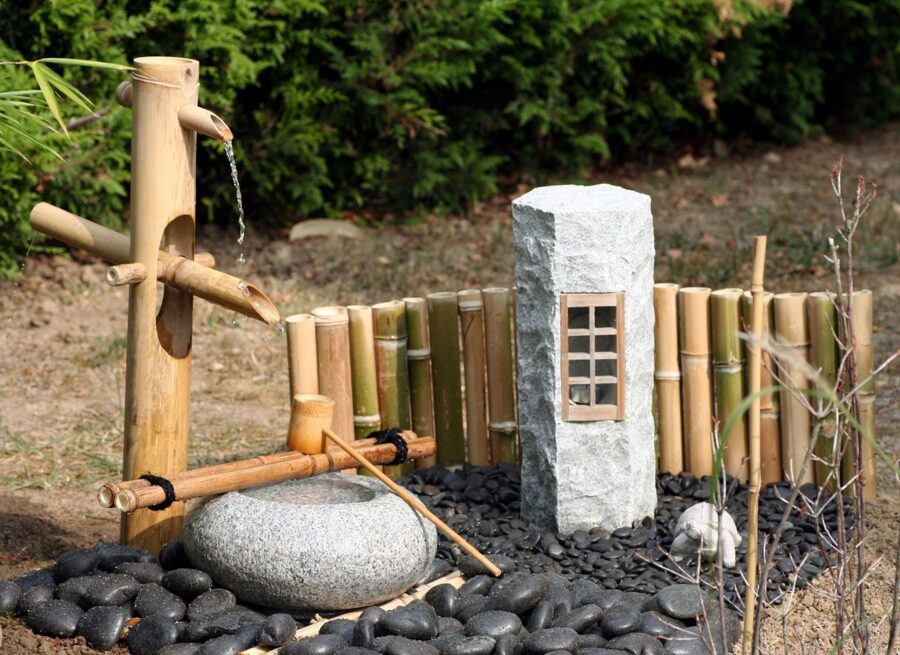
Shishi-odoshi (鹿威し) is 鹿 deer plus 威し, scaring. Its older name, sōzu (添水), is a puzzle: dictionaries list the monk’s title 僧都 and an old word for scarecrow, and back neither. A bamboo tube on a pivot fills with water, tips, empties and swings back to knock on a stone.
It began in fields to scare off deer and wild boar and was taken into gardens for its sound. Poets made 添水 an autumn season word in haiku.
The one everybody knows is at Shisen-dō in northern Kyoto, the retreat of the scholar Ishikawa Jōzan.
The people behind the words
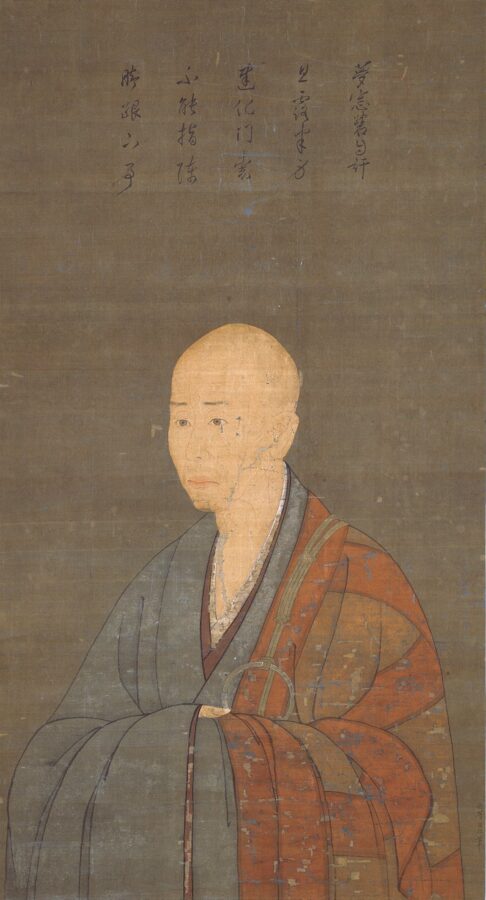
Musō Soseki (1275–1351), Zen abbot and the great garden maker of his century, restored Saihō-ji in 1339 and laid out the pond at Tenryū-ji. After him come Zen’ami, Sen no Rikyū, Kobori Enshū (1579–1647) and Shigemori Mirei.
None of them signed their work, and later centuries attached their names to gardens they never touched. When a guide says a garden “is by” Enshū, read “is said to be by”.
A short glossary of garden terms
| Term | Kanji | Reading | Meaning |
|---|---|---|---|
| niwa | 庭 | にわ | garden; first, a place where work or ritual is done |
| teien | 庭園 | ていえん | garden (formal, a Meiji-era word) |
| karesansui | 枯山水 | かれさんすい | dry garden of stone and sand |
| chisen kaiyū-shiki | 池泉回遊式 | ちせんかいゆうしき | pond garden made to walk round |
| roji | 露地 | ろじ | tea garden path |
| shakkei | 借景 | しゃっけい | borrowed scenery |
| tsukiyama | 築山 | つきやま | built hill |
| suhama | 州浜 | すはま | pebble shore |
| tobi-ishi | 飛石 | とびいし | stepping stones |
| tōrō | 灯籠 | とうろう | lantern |
| tsukubai | 蹲踞 | つくばい | low washing basin |
| shishi-odoshi, sōzu | 鹿威し, 添水 | ししおどし, そうず | bamboo deer scarer |
| sekimori-ishi | 関守石 | せきもりいし | rope-tied “no entry” stone |
| samon | 砂紋 | さもん | raked sand pattern |
| yukitsuri | 雪吊り | ゆきつり | snow ropes on trees |
Where to see each kind
Adult admission and hours from each garden’s own site, as of November 2026.
| Kind | Garden | Where | Adults | Hours |
|---|---|---|---|---|
| Karesansui | Ryōan-ji | Kyoto | ¥600 (about $4) | 8:00–17:00 (Dec–Feb 8:30–16:30) |
| Chisen kaiyū | Kenrokuen | Kanazawa | ¥320 (about $2) | 7:00–18:00 (16 Oct–Feb 8:00–17:00) |
| Chisen kaiyū, shakkei | Ritsurin Garden | Takamatsu | ¥500 (about $3) | about sunrise to sunset (Jan 7:00–17:00; Jun–Aug 5:30–19:00) |
| Roji, suhama, tobi-ishi | Katsura Imperial Villa | Kyoto | ¥1,000 (about $7), 18 and over | guided tours only, starts 9:00–16:20; closed Mondays |
| Shishi-odoshi | Shisen-dō | Kyoto | ¥700 (about $5) | 9:00–17:00, closed 23 May |
If you can see only one, make it Katsura for the walk and Ryōan-ji for the words. Go to Ryōan-ji when it opens, sit on the veranda and count. Whether you find fifteen stones or fourteen, the name on the gate has already told you what is missing: the water.