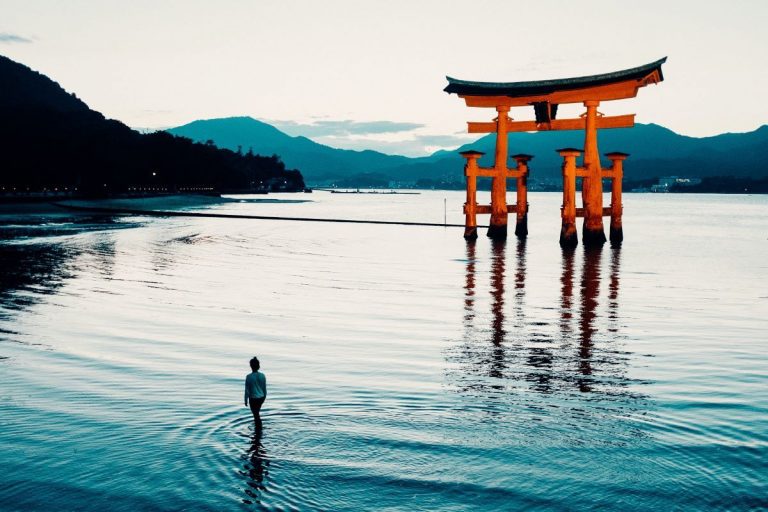
Climate, 気候,
きこう
- Japan belongs to the temperate zone with four distinct
seasons, but its climate varies from cool temperate in the
north to subtropical in the south. The climate is also
affected by the seasonal winds that blow from the continent
to the ocean in winters and vice versa in summers.
Japan is generally a rainy country with high humidity.
Because of its wide range of latitude, Japan has a variety
of climates, with a range often compared to that of the east
coast of North America, from Nova Scotia to Georgia. Tokyo
is at about 35 north latitude, comparable to that of Tehran,
Athens, or Las Vegas, Nevada. The generally humid, temperate
climate exhibits marked seasonal variation celebrated in art
and literature, as well as regional variations ranging from
cool in Hokkaidō to subtropical in Kyūshū. Climate also
varies with altitude and with location on the Pacific Ocean
or on the Sea of Japan. Northern Japan has warm summers but
long, cold winters with heavy snow. Central Japan has hot,
humid summers and short winters, and southwestern Japan has
long, hot, humid summers and mild winters.
Two primary factors influence Japan's climate: a location
near the Asian continent and the existence of major oceanic
currents. The climate from June to September is marked by
hot, wet weather brought by tropical airflows from the
Pacific Ocean and Southeast Asia. These airflows are full of
moisture and deposit substantial amounts of rain when they
reach land. There is a marked rainy season, beginning in
early June and continuing for about a month. It is followed
by hot, sticky weather. Five or six typhoons pass over or
near Japan every year from early August to early September,
sometimes resulting in significant damage. Annual
precipitation, which averages between 100 and 200
centimeters (39–78 inches), is concentrated in the period
between June and September. In fact, 70 to 80 percent of the
annual precipitation falls during this period. In winter, a
high-pressure area develops over Siberia, and a low-pressure
area develops over the northern Pacific Ocean. The result is
a flow of cold air eastward across Japan that brings
freezing temperatures and heavy snowfalls to the central
mountain ranges facing the Sea of Japan, but clear skies to
areas fronting on the Pacific.
Two major ocean currents affect this climatic pattern: the
warm Kuroshio Current (Black Current; also known as the
Japan Current); and the cold Oyashio Current (Parent
Current; also known as the Okhotsk Current). The Kuroshio
Current flows northward on the Pacific side of Japan and
warms areas as far north as Tokyo; a small branch, the
Tsushima Current, flows up the Sea of Japan side. The
Oyashio Current, which abounds in plankton beneficial to
coldwater fish, flows southward along the northern Pacific,
cooling adjacent coastal areas. The meeting point of these
currents at 36 north latitude is a bountiful fishing ground.
Information source: “Geography of Japan.” wikipedia.org.
Article date: 31 Jan. 2008. Retrieved: Wikipedia. 2 Feb.
2008 <Geography
of Japan>. |
|
|
|